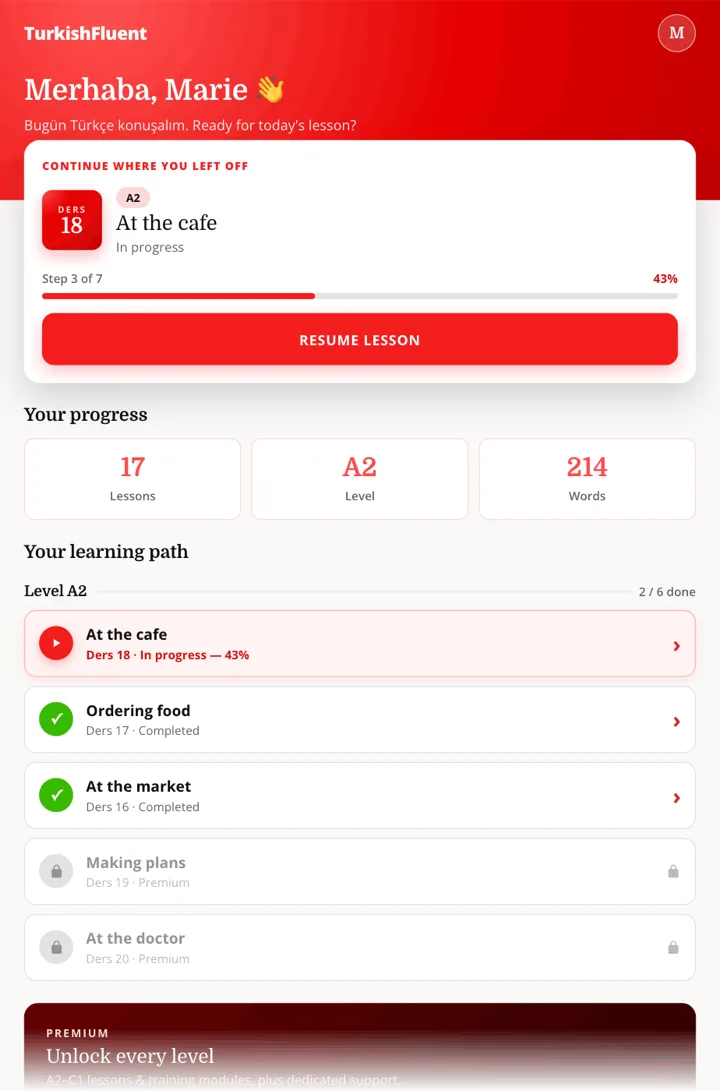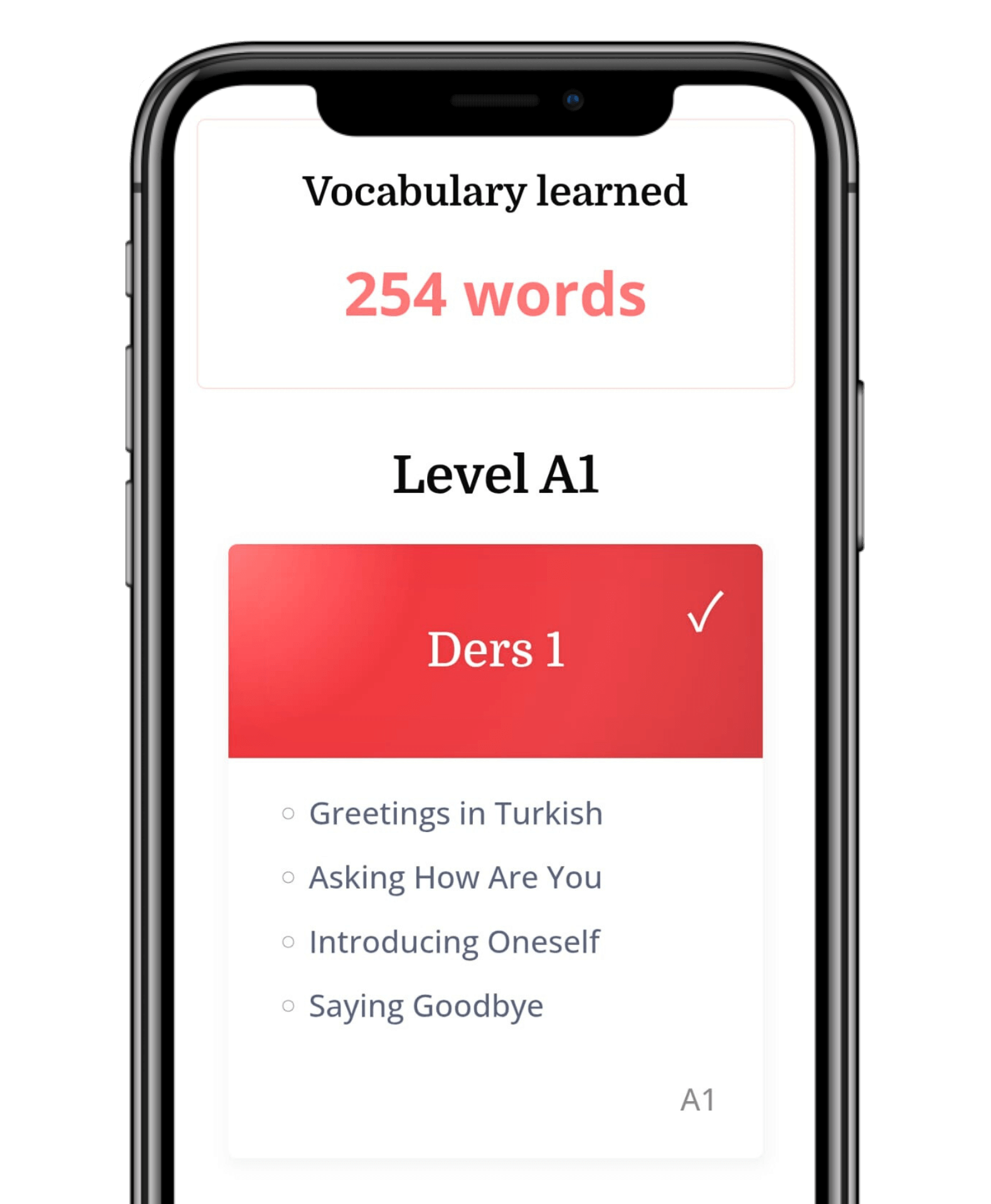
People call Turkish exotic, impossibly complex, a language of endless suffixes. The truth is more encouraging: Turkish is moderately hard for English speakers. Yet it rewards you with a phonetic alphabet, zero grammatical gender, and rules so consistent they almost feel mathematical.
In this article, you will learn what makes Turkish challenging and what makes it surprisingly easy. You will also see how long fluency really takes and the smartest ways to shorten that road. By the end, you will know exactly what you are signing up for. Haydi başlayalım!
Table of Contents
Is Turkish Hard to Learn? The Quick Verdict
Turkish is not a “super-hard” language like Arabic or Japanese. However, it sits clearly above French or Spanish in difficulty for English speakers. The challenge comes from one thing above all. Turkish belongs to the Turkic language family, so it shares almost no vocabulary or structure with English.
Here is an honest, aspect-by-aspect breakdown before we dig into the details.
| Aspect | Difficulty | Why |
|---|---|---|
| Alphabet & spelling | Easy | Latin script, fully phonetic (Thanks Atatürk!) |
| Pronunciation | Easy to moderate | A few new vowels, but no tones |
| Gender & articles | Easy | Turkish has neither |
| Vocabulary | Moderate to hard | Very few cognates with English |
| Word order (SOV) | Moderate | The verb comes last |
| Vowel harmony | Moderate | Logical, fully consistent rules |
| Agglutination (suffixes) | Hard | Words are built by stacking suffixes |
As you can see, the picture is mixed. Several features actually make Turkish easier than the languages you studied in school. Let us start with the good news.
Order that çay in Turkish
Become fluent in Turkish with real-life dialogues & interactive exercises tailored for expats living in Türkiye.
What Makes Turkish Easier Than You Expect
Turkish carries a scary reputation, yet it hands you several genuine gifts. These features remove entire categories of memorization that slow learners down in other languages.
First, the alphabet. Turkish uses a 29-letter version of the Latin script, and it is almost perfectly phonetic. In other words, you pronounce words exactly as they are written. Once you learn the sounds, you can read any word aloud correctly, which is something French or English never offer. For a full walkthrough, see our guide to the Turkish alphabet.
Second, Turkish has no grammatical gender. German learners, rejoice! Nouns are not masculine or feminine, so you never memorize gender or adjust articles to match. Even better, a single pronoun o covers “he,” “she,” and “it.” Context tells you which one is meant.
Third, Turkish has no gendered articles. There is no word for “the,” and no gendered “a” or “an” like German’s ein/eine or French’s un/une. Therefore, you skip the article-and-gender drilling that trips up learners of those languages. Definiteness still exists, yet Turkish signals it with a suffix rather than a separate word. A definite direct object simply takes the accusative ending, as in kitabı okudum (I read the book) instead of “the”.
Fourth, the rules are remarkably regular. Turkish grammar follows consistent patterns with very few exceptions. Therefore, once you learn a rule, you can apply it across the board without a long list of irregular forms to memorize.
Finally, you already know more Turkish words than you think. Over the centuries, Turkish absorbed thousands of words from Arabic, Persian, French, Italian, and other languages, layered in through religion, trade, and modernization.
So whichever of these languages you already speak, you will recognize familiar words and pick up Turkish vocabulary faster. The table below ranks the main sources by how many words each one contributed.
| Source language | Words in modern Turkish | Everyday example |
|---|---|---|
| Arabic | ~6,500 | kitap (book) |
| French | ~5,000 | şoför (driver) |
| Persian | ~1,400 | şehir (city) |
| Italian | ~630 | iskele (pier) |
| English | ~540 | tişört (t-shirt) |
| Greek | ~400 | liman (harbor) |
Figures come from the Turkish Language Association (TDK), Türkçe Sözlük (10th ed.). Arabic and Persian entered through religion, law, and poetry, while French, Italian, Greek, and English arrived later through trade, ports, and modernization.
French ran so deep among the Ottoman elite that it even shaped Turkish idioms. The expression Fransız kalmak, literally “to stay French,” still means to be clueless about something. It traces back to elites who spoke fluent French but barely understood Turkish, leaving them lost in everyday local conversation.
What Makes Turkish Challenging
Now for the honest part. The difficulty of Turkish is real, and it shows up in both grammar and vocabulary. A handful of features in particular ask you to adjust how you learn, whatever your native language.
Word Order: The Verb Comes Last
English, French, Spanish, and most European languages follow a subject-verb-object order. Turkish, by contrast, follows a subject-object-verb (SOV) pattern, so the verb almost always lands at the end. At first this feels backwards, yet it becomes intuitive with exposure.
- Ben kitap okurum. (I read a book. Literally: “I book read.”)
- O çay içer. (He or she drinks tea. Literally: “He/she tea drinks.”)
To go deeper, explore our breakdown of Turkish sentence structure.
Vowel Harmony: Sounds That Match
Turkish vowels follow a system called vowel harmony, where the vowels inside a word align with each other. Consequently, suffixes change shape to match the last vowel of the word they attach to. The plural ending, for example, is either -ler or -lar.
- elma (apple) becomes elmalar (apples).
- şişe (bottle) becomes şişeler (bottles).
This may sound like extra work, yet the rules are few and 100% consistent. Moreover, the pattern follows the natural shape of your mouth, so it quickly becomes automatic. Our full guide to vowel harmony explains every rule you need to know.
Agglutination: Words Built Like Trains
Here is the feature that defines Turkish. The language is agglutinative, which means you build meaning by stacking suffixes onto a root word. One Turkish word can carry what an entire English sentence expresses.
Watch a single root grow, step by step:
- ev (house)
- evler (houses)
- evlerim (my houses)
- evlerimde (in my houses)
- evlerimdeydi (it was in my houses)
Each suffix adds one precise piece of meaning. The logic is beautiful once it clicks, yet stacking suffixes in the right order takes practice. Specifically, you must remember not just the word, but the correct sequence of endings. This is hard in a conversation as your brain needs to analyze every suffix used.
Vocabulary: Few Familiar Footholds
The core of Turkish is pure Turkic, and those everyday words look completely new. Because most of Turkish is unrelated to English and the major European languages, you cannot guess them through shared roots. The loanwords above help, yet they cover only a slice of daily speech. As a result, vocabulary building demands steady, consistent effort, especially in the early months.
Ottoman Leftovers and Hidden Doublets
Centuries of Arabic and Persian borrowing left another twist. The language reform of the 1930s revived old Turkic words to replace many of them, yet the originals never fully disappeared. So you often learn two words for the same idea, one old and one new.
- isim (Arabic) and ad (Turkish), both meaning “name”
- şehir (Persian) and kent (Turkish), both meaning “city”
- cevap (Arabic) and yanıt (Turkish), both meaning “answer”
Older speakers and formal texts lean on the Ottoman-era words, while younger speakers prefer the modern Turkic ones. Knowing both is part of sounding natural.
Spoken Turkish vs. Written Turkish
Finally, the gap between speech and writing can catch you off guard. Everyday spoken Turkish is plain and direct. Formal writing, news, and literature, by contrast, still reach for the heavier Arabic and Persian vocabulary inherited from Ottoman times. Therefore, you may chat comfortably at a café yet stumble over a newspaper headline. Closing that gap simply takes extra reading and practice.
How Long Does It Take to Learn Turkish?
The most respected benchmark comes from the U.S. Foreign Service Institute, which trains American diplomats. The FSI sorts languages into categories by difficulty for English speakers.
Turkish sits in Category IV, the “hard languages” group. According to the FSI, reaching professional working proficiency takes roughly 44 weeks, or about 1,100 class hours. The table below puts that number in context.
| FSI Category | Example languages | Time to proficiency |
|---|---|---|
| I | French, Spanish, Italian | 24–30 weeks (600–750 hours) |
| II | German | 30 weeks (750 hours) |
| III | Indonesian, Swahili | 36 weeks (900 hours) |
| IV | Turkish, Russian, Hindi | 44 weeks (1,100 hours) |
| V | Arabic, Japanese, Korean, Chinese | 88 weeks (2,200 hours) |
Notice the key takeaway. Turkish takes about half the time of Arabic or Japanese. So while it is harder than the Romance languages, it is nowhere near the hardest tier.
Furthermore, these figures assume intensive classroom study. Your own timeline depends on your motivation, your study habits, and how much you immerse yourself.
How to Make Learning Turkish Easier
The difficulty of Turkish drops sharply once you adopt the right approach. The learners who succeed share a few habits, and you can copy them from day one.
Above all, practice daily. Short, consistent sessions beat rare marathon ones, because language sticks through repetition and spaced exposure. Even ten focused minutes a day will outperform a single long session each week.
Next, lean into the language’s logic. Since Turkish rules are so regular, a little grammar study pays off enormously. Learn the pattern once, then apply it everywhere. Pair that grammar with high-frequency vocabulary, like the most-used Turkish verbs, so your effort targets the words you actually need.
Finally, surround yourself with real Turkish. Listen to native speakers, watch Turkish shows, and repeat phrases out loud to train your ear and mouth together. This kind of immersion is exactly what the TurkishFluent app is built around.
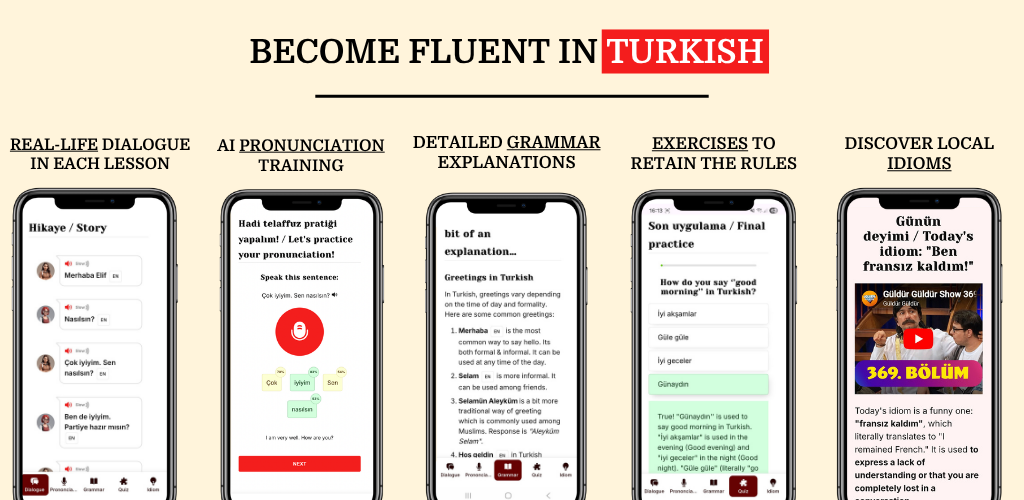
Its lessons combine structured grammar from a professional teacher with dialogues recorded by native speakers. You hear each dialogue at normal and slow speed, then get instant pronunciation feedback powered by AI. A set of exercices help you learn the grammar and new vocabulary. Each lesson takes about ten minutes, which makes the daily-practice habit easy to keep. In short, it turns the scattered advice above into one simple routine.
For more options, browse our roundup of useful resources for learning Turkish.
Is Turkish Harder Depending on Your Native Language?
No one learns Turkish from a blank slate. You always bring a native language, and that starting point shapes how steep the climb feels. Turkish leans harder on some speakers than others, mostly through vocabulary overlap and a few shared sounds. Here is how the challenge shifts depending on where you start.
| Your native language | Relative difficulty | Biggest advantage | Biggest hurdle |
|---|---|---|---|
| English | Moderately hard | Latin alphabet and a wave of European loanwords feel familiar from day one | SOV word order, vowel harmony, and suffix stacking are all new |
| Romance (French, Spanish, Portuguese, Italian) | Moderately hard | Latin alphabet, plus ~5,000 French loanwords already living in Turkish | Agglutination, vowel harmony, and SOV order feel completely foreign |
| German | Slightly easier | Shares the ö and ü sounds, and verb-final subordinate clauses soften SOV order | Vowel harmony and stacked suffixes still take real practice |
| Arabic | Easier on vocabulary | Thousands of shared words across religion, law, and daily life | Latin script, SOV order, and agglutination are all unfamiliar |
| Persian (Farsi) | Easier on vocabulary | Shares SOV order, ~1,400 words, and a deep poetic vocabulary | Suffix stacking, vowel harmony, and learning the Latin script |
| Hindi / Urdu | Moderate | SOV order feels native, and Urdu shares deep Persian and Arabic vocabulary | Vowel harmony, suffix stacking, and a new alphabet |
| Japanese | Moderate | SOV order and suffix-based agglutination work almost exactly like Turkish | No shared vocabulary at all, plus vowel harmony to master |
| Russian | Moderately hard | Case endings and rich word-building already feel natural | Distant vocabulary, vowel harmony, and unfamiliar suffix logic |
| Mandarin Chinese | Hard | Already comfortable with no gender, articles, or plurals | Suffixes, case endings, vowel harmony, and unrelated vocabulary |
Conclusion
So, is Turkish hard to learn? Moderately, and honestly so. The grammar asks you to think in a new way. Suffixes stack like train cars, and the verb waits patiently at the end of the sentence. Yet the language meets you halfway with a phonetic alphabet, no gender, no articles, and rules you can actually trust.
From your first merhaba to ordering a çay like a local, the path is challenging but never impossible. The cultural reward at the end is enormous. Turkish opens a country where a few well-placed words turn strangers into friends.
To keep building momentum, discover the many reasons to learn Turkish and let that motivation carry you through the first few months. Kolay gelsin!