Duolingo is the first app most people open when they decide to learn Turkish, and I was no exception. I stuck with it for months and finished the whole Turkish tree, so here is my honest review after completing the Turkish course on Duolingo.
Can a green owl really teach a language built on stacked suffixes and vowel harmony? My answer is nuanced, because how much you get out of the app depends heavily on what you expect from it.
In this article, you will learn how Duolingo teaches Turkish, what it genuinely does well, where it struggles with Turkish specifically, and how far it can realistically take you. You will also see who the app suits, who should skip it, and how to use it smartly instead of relying on it alone. Haydi başlayalım!
| What Duolingo does well | Where it falls short for Turkish |
|---|---|
| Builds a daily habit through gamification | Rarely explains grammar rules |
| Free at the core, low financial risk | Leaves agglutination and vowel harmony to guesswork |
| Teaches basic vocabulary and sentence patterns | Tree ends around the upper-beginner level |
| Trains reading and listening comprehension | Offers thin, scripted speaking practice |
| Requires only a few minutes a day | Gives no personalized feedback on mistakes (except for Premium users) |
Table of Contents
How Duolingo Teaches Turkish
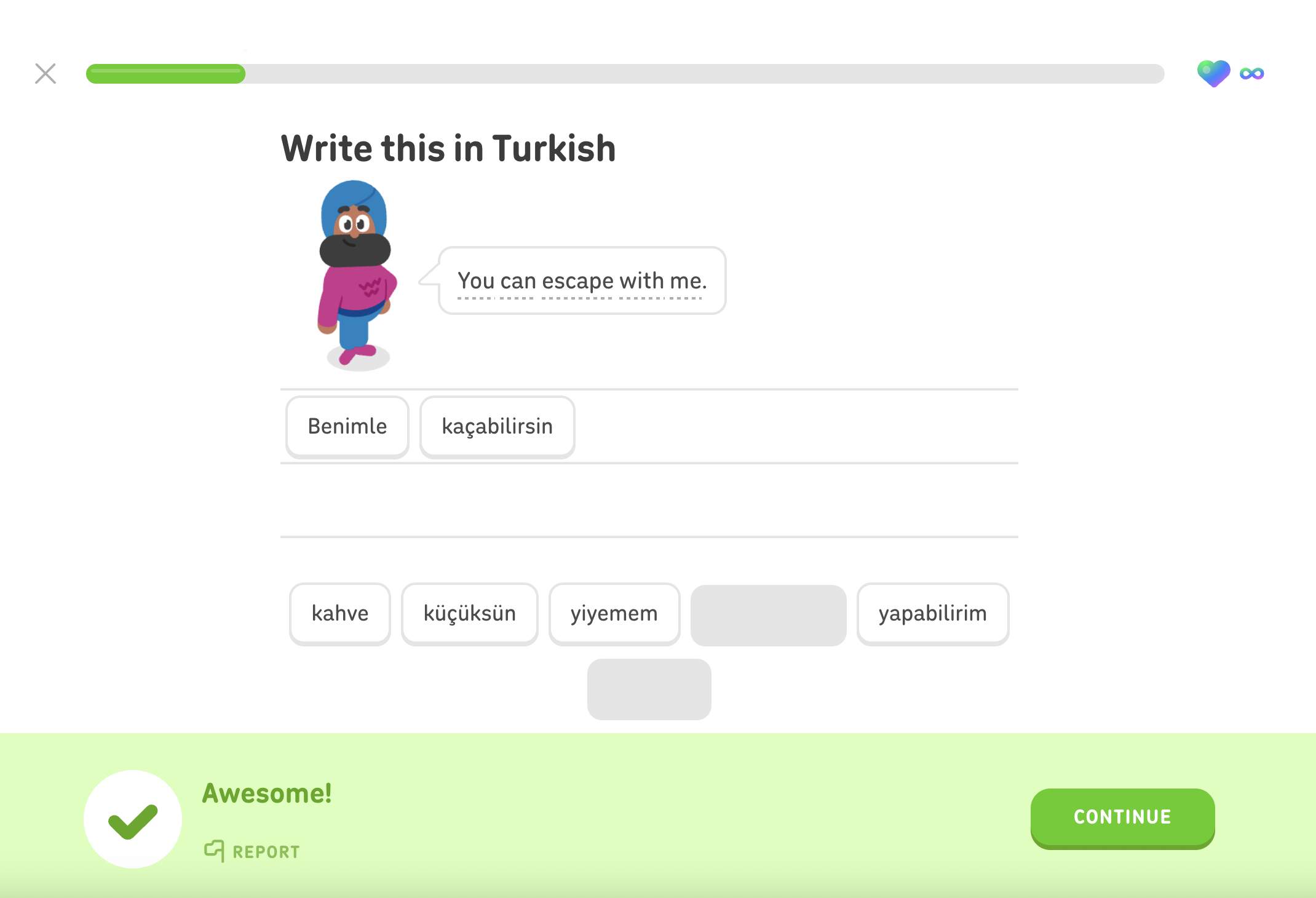
Duolingo runs on one core idea: learning through short, gamified lessons. You follow a path of units, and each unit contains bite-sized exercises. Most of these exercises ask you to translate sentences, match words, tap the right option, or repeat a phrase aloud.
The method leans on repetition and pattern recognition. Instead of reading a rule and then applying it, you see many examples and slowly absorb the pattern. For example, the app shows you dozens of sentences with -de and -da until the locative ending starts to feel familiar. This works reasonably well for vocabulary and common structures.
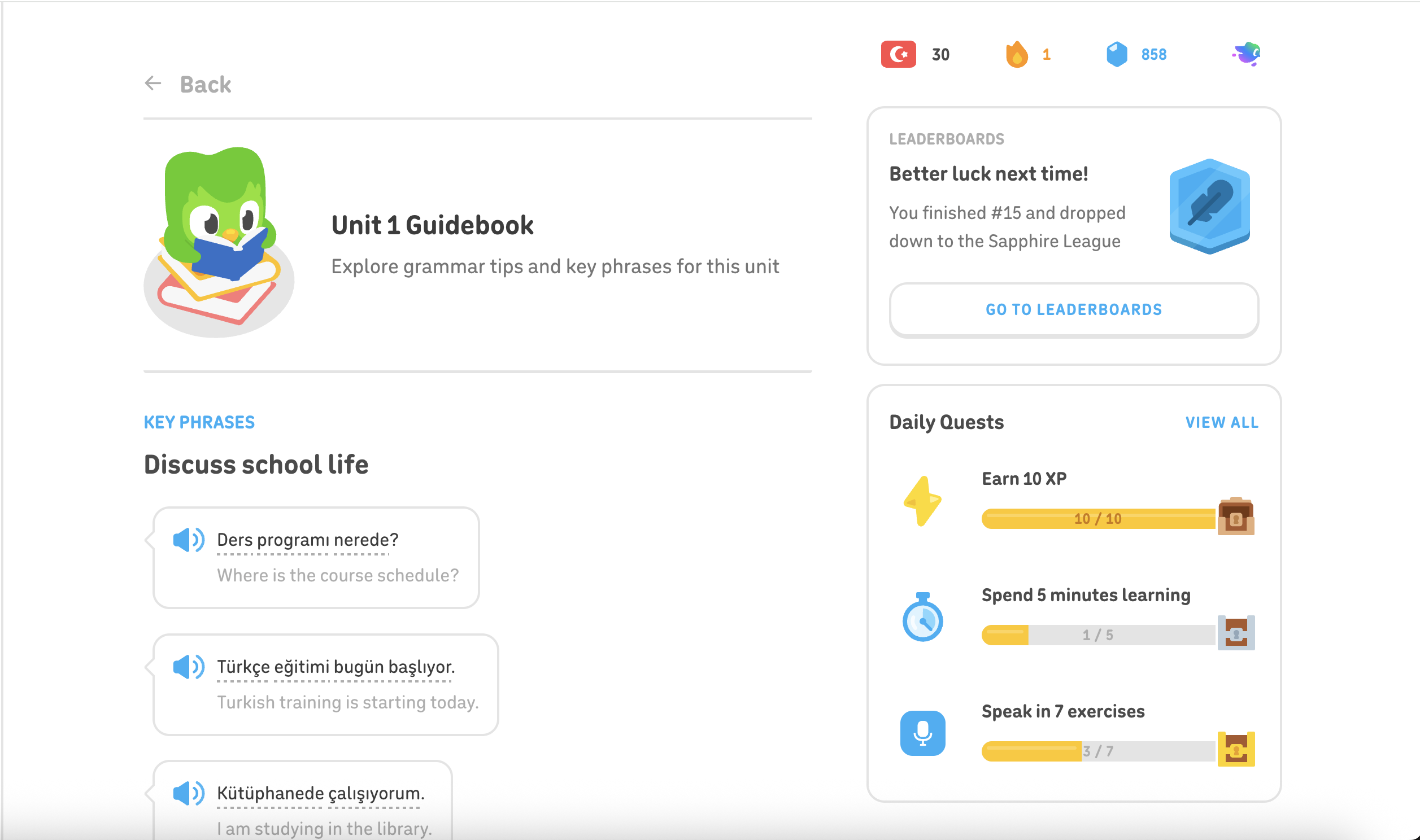
Each unit also opens with a short guidebook. It offers a few grammar tips and a preview of what the unit covers. However, this guidebook stays basic, and many learners skip it entirely. As a result, most of your time goes into tapping answers rather than understanding why Turkish behaves the way it does.
The Turkish course itself was originally built by volunteers. Consequently, it has received fewer updates than Duolingo’s flagship courses like Spanish or French. That matters for how deep the content goes, as you will see below.
Order that çay in Turkish
Become fluent in Turkish with real-life dialogues & interactive exercises tailored for expats living in Türkiye.
What Duolingo Does Well
Let me be clear before the criticism starts: Duolingo has real strengths. Dismissing it entirely would be unfair and, frankly, inaccurate. Especially for a free app!
It Builds a Daily Habit
The biggest win is consistency. Duolingo turns study into a game, complete with streaks, points, and gentle reminders. For many learners, this is the difference between practicing every day and quitting after a week. Language learning rewards steady exposure, and the app is engineered to keep you coming back.
Moreover, the lessons are genuinely short. You can finish one in a few minutes, which removes the excuse of not having time. Therefore, Duolingo fits neatly into a commute, a coffee break, or the last minutes before sleep.
It Is Free and Low-Pressure
The core of Duolingo costs nothing. You can reach the end of the Turkish tree without paying, as long as you tolerate ads and a limited number of hearts. For a curious beginner testing the waters, this removes all financial risk.
In addition, the tone is welcoming. Nothing about the app feels intimidating or academic. As a result, people who were scared off by grammar textbooks often stick with Turkish here, at least for a while.
It Covers the Basics
Duolingo does teach you real, usable Turkish at the beginner level. You will pick up greetings, numbers, colors, food words, and simple present-tense sentences. You will also start recognizing frequent verbs and everyday nouns.
By the early units, you can understand short written sentences and produce basic ones yourself. For instance, you learn to say Ben su istiyorum (I want water) or Bu ne? (What is this?). That is a genuine foundation, and it should not be underrated.
Honestly, this is where Duolingo delivered the most for me. As a way to soak up new beginner vocabulary a few minutes a day, it genuinely works, and I still keep it for exactly that.
Where Duolingo Struggles With Turkish Specifically
Here is where the review turns critical. Turkish is not Spanish, and the app’s method collides with the way the language actually works.
Grammar Is Rarely Explained
Turkish grammar is logical, but it is also unfamiliar to English speakers. It relies on suffixes, cases, and harmony rules that follow clear systems. Unfortunately, Duolingo mostly leaves these systems unexplained.
The app shows you correct sentences and expects you to infer the rule. For a language like Turkish, this creates real gaps. You might use the accusative case correctly in one sentence and wrongly in the next, without ever understanding the difference. Consequently, many learners reach the middle of the tree feeling that Turkish is “random,” when in fact it is highly regular.
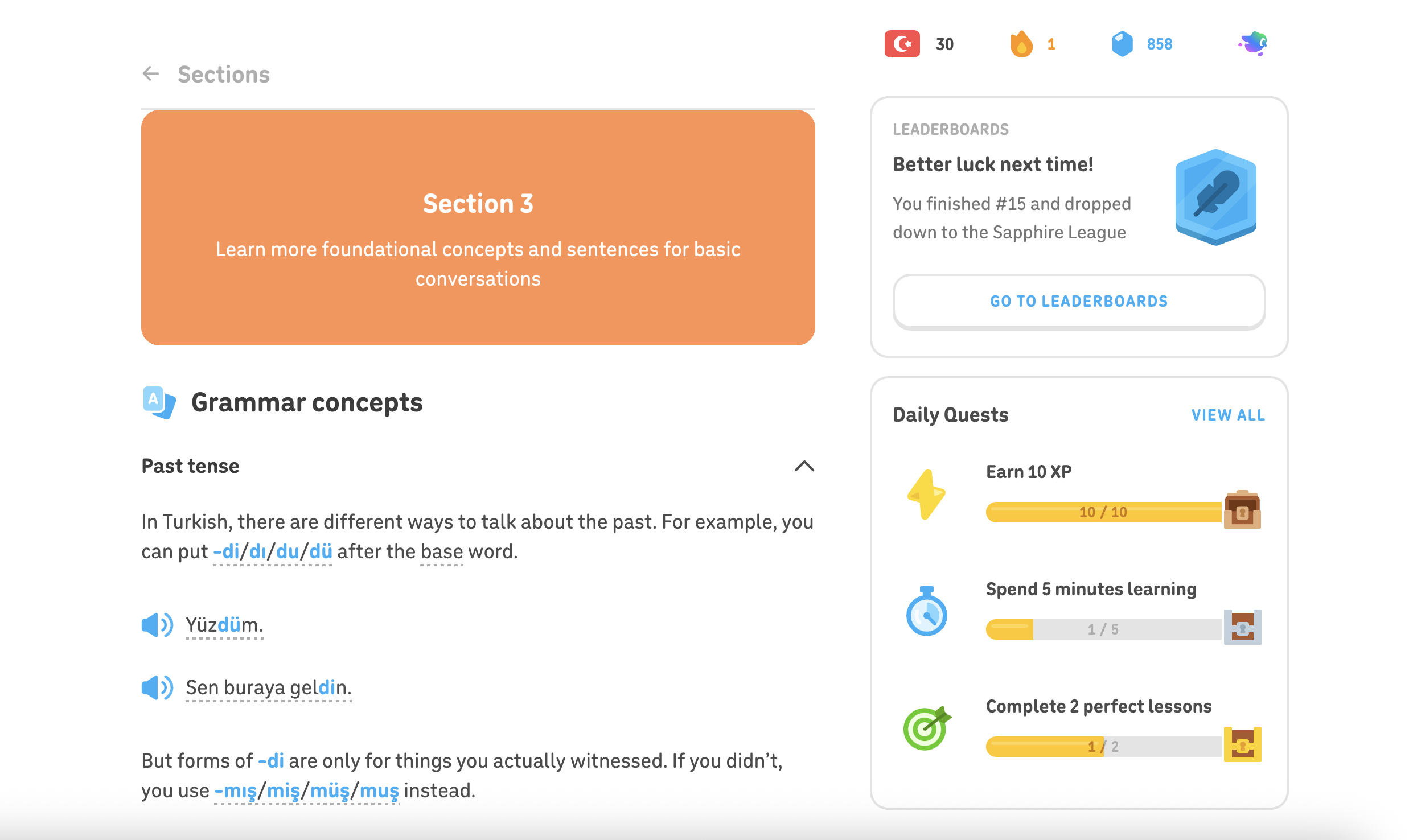
This was my single biggest frustration with the app. By the middle of the tree, I could tap the right answers without being able to explain why, and that is the exact moment I realized I needed a proper grammar course or a teacher alongside it. In my opinion, that complement is not optional for Turkish, it is mandatory.
Agglutination and Vowel Harmony Are Guessed, Not Taught
Turkish is an agglutinative language. This means you build words by stacking suffixes onto a root, and each suffix must obey vowel harmony. The word evlerimizden (from our houses) packs four pieces of meaning into one word.
Duolingo doesn’t really break this process down. You see the finished word, yet you seldom learn how it was assembled. Take evlerimizden apart and it reads clearly: ev (house) plus -ler (plural) plus -imiz (our) plus -den (from). Each piece follows a rule, and each vowel bends to match the ones before it. Once you know the system, you can build the word from nothing.
Without that system, you are left copying. As a result, you can recognize evlerimizden when reading, but struggle to build a new word yourself under the same rules. I felt this the first time I tried to speak: I could read the word fine, but assembling my own on the spot was a completely different skill, and Duolingo had never trained it.
The Tree Ends at the Upper-Beginner Level
Duolingo’s Turkish course does not go far up the ladder. Most estimates place its ceiling at roughly the A2 level, which is upper-beginner. In other words, you will handle simple daily topics, but not real conversations about work, opinions, or abstract ideas.
For comparison, holding a natural conversation usually requires at least a solid B1. The Turkish tree simply does not reach that far. Therefore, even a learner who finishes every lesson will hit a wall well before fluency.
This matches my own experience exactly. I completed every lesson and still landed around A2, early B1 at the very best. Do not expect Duolingo to take you further than that on its own.
Speaking Practice Stays Thin
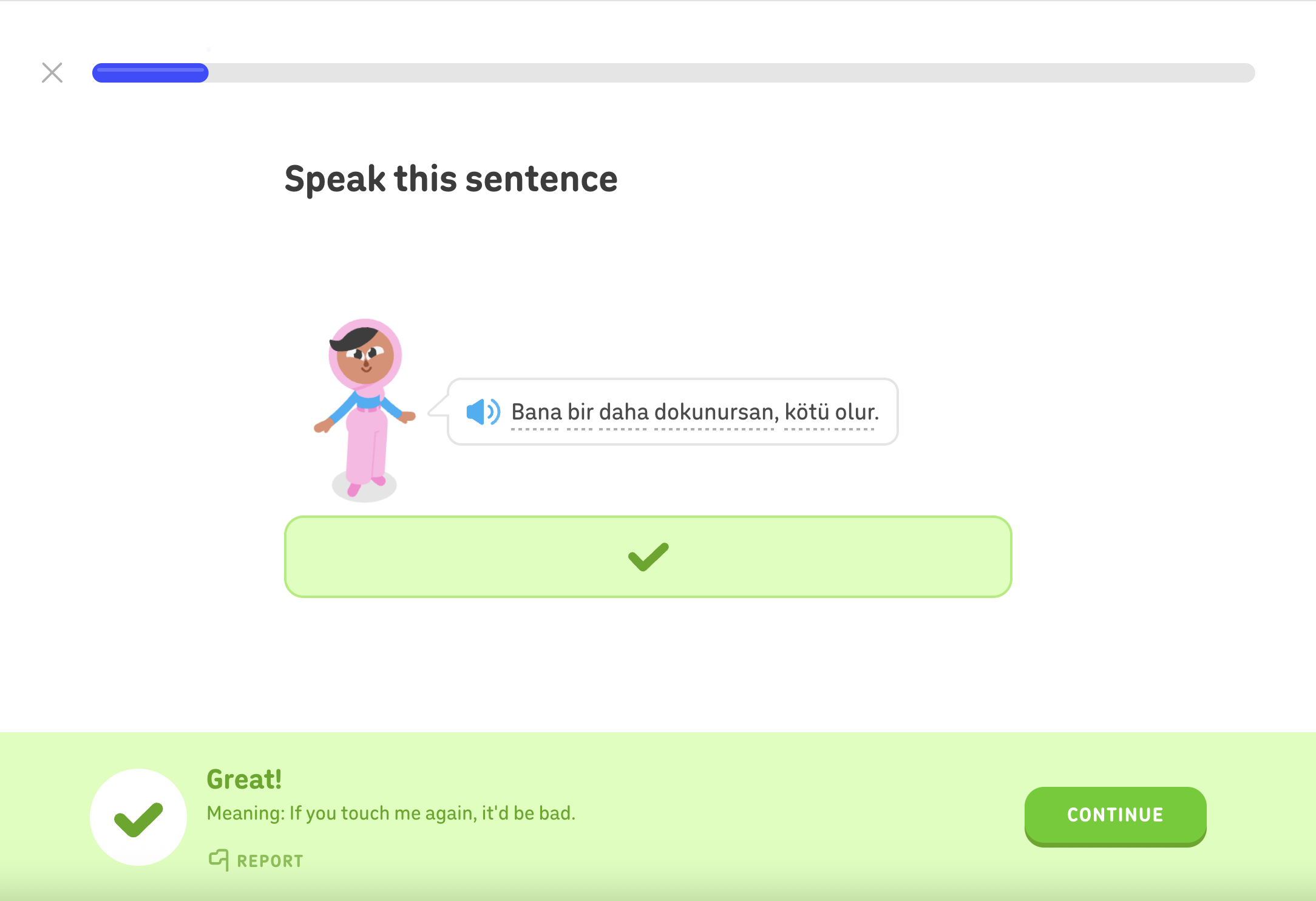
Speaking is where most learners want results, and it is where Duolingo is weakest. The app includes some speaking exercises, but they ask you to repeat scripted sentences. Nothing pushes you to form your own thoughts or respond in real time.
Furthermore, the app gives no meaningful feedback on your pronunciation beyond a rough pass or fail. It will not tell you that your ı sounds like an i, or that you are stressing the wrong syllable. So while you may read and tap confidently, your mouth stays untrained for the messy reality of live conversation.
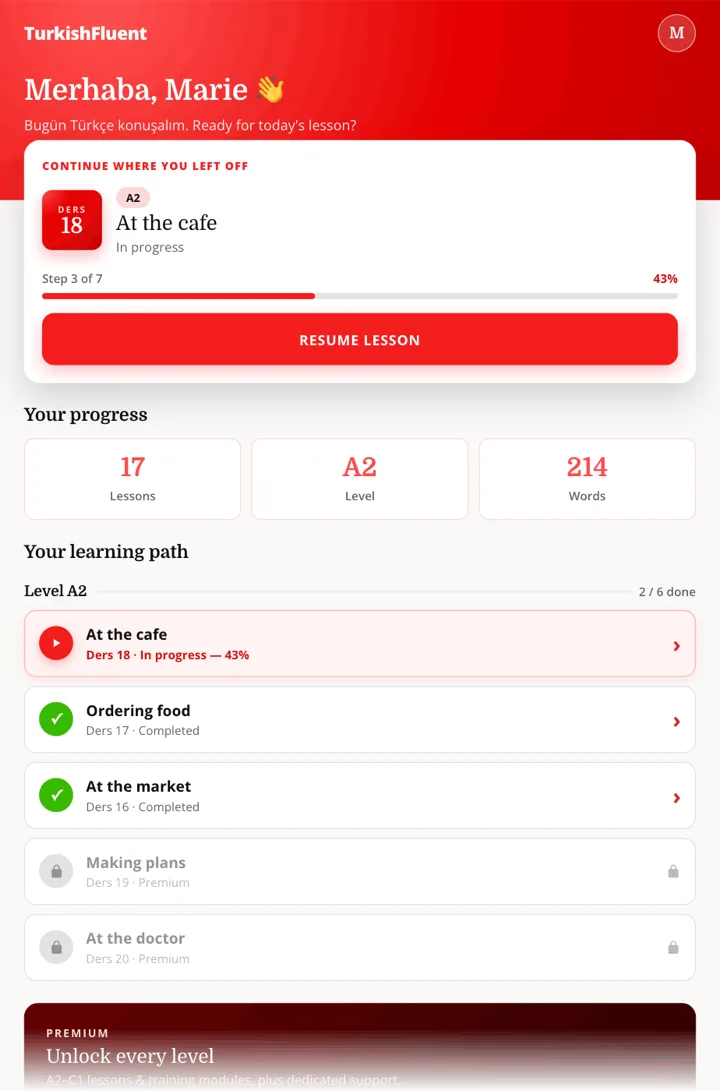
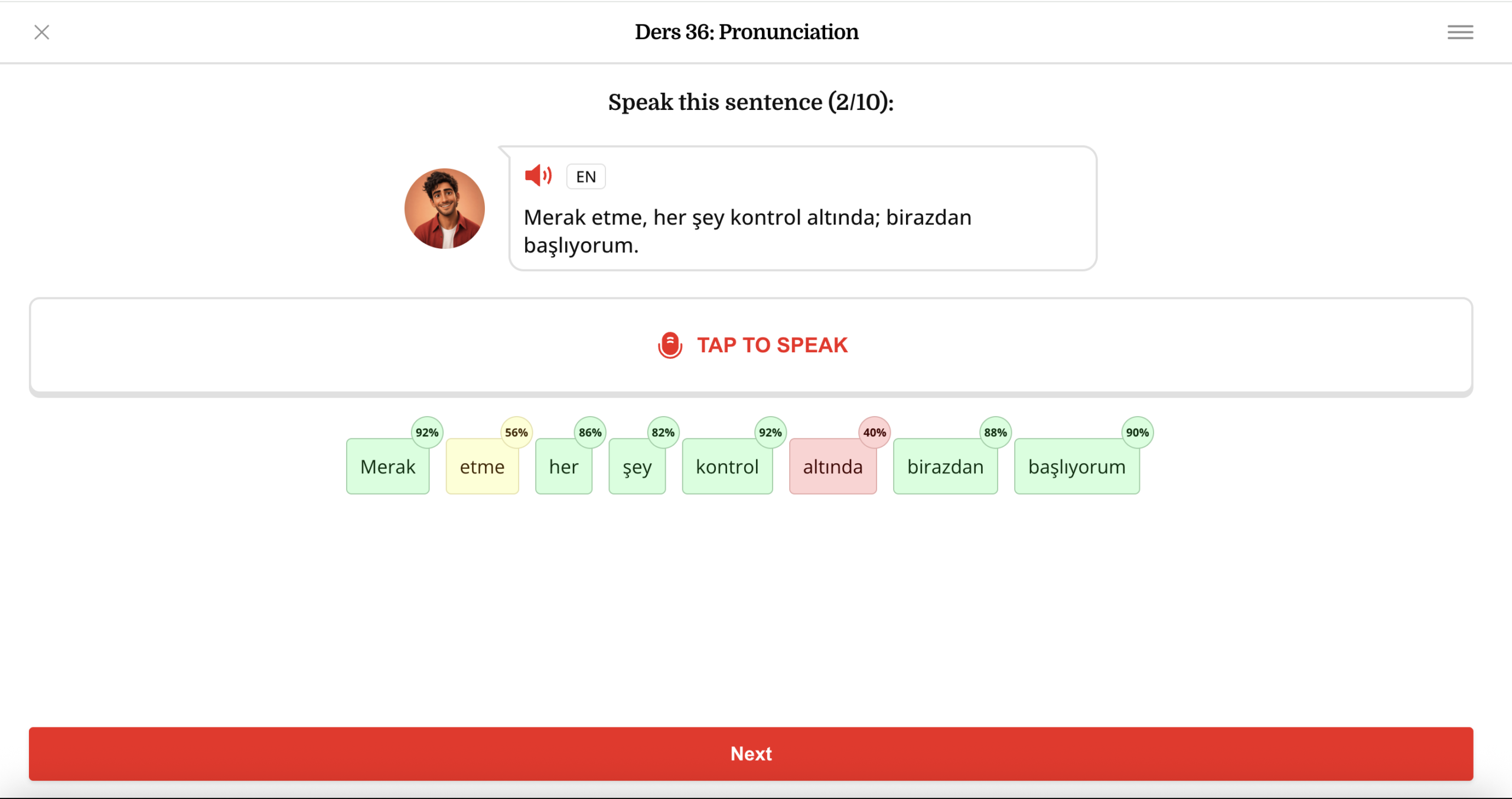
The contrast with a pronunciation-focused tool is stark. When I practice the same kind of sentence in TurkishFluent, the app scores every single word as a percentage, so I know exactly which sounds still need work.
Nothing exposed this faster for me than real life. The moment I had to speak with actual people, I understood that no amount of daily tapping replaces real conversation. Keep Duolingo for the habit, but treat speaking with real Turks as non-negotiable.
How Far Duolingo Realistically Takes You
Time for a straight answer. If you complete the entire Turkish tree and take it seriously, you can expect to land somewhere around the A2 level. You will read simple texts, understand slow and clear speech, and survive basic tourist situations.
That is a real achievement, and it is nothing to dismiss. However, it falls short of conversational Turkish. You will not chat comfortably with your partner’s family, argue about football, or explain a problem at the pharmacy without hunting for words.
The honest verdict is this: Duolingo is an excellent on-ramp and a poor destination. It gets you moving and keeps you consistent, which matters enormously at the start. Nevertheless, it cannot carry you to fluency on its own, especially for a structurally rich language like Turkish. To understand why the climb takes effort, it helps to read whether Turkish is hard to learn and how long learning Turkish actually takes.
Who Duolingo Is Right For (and Who Should Skip It)
Duolingo is a great fit for specific learners. It suits you well if you:
- Are just starting and want a low-pressure taste of Turkish.
- Struggle with motivation and need gamification to stay consistent.
- Want a free tool to build vocabulary alongside other methods.
- Have a trip coming up and want survival basics fast.
On the other hand, Duolingo alone disappoints certain learners. You should look beyond it if you:
- Live in Turkey and need to actually converse with people around you.
- Want to understand why Turkish works, not just memorize sentences.
- Aim for B1 or higher for work, study, or a serious relationship.
- Already feel stuck because the grammar never clicks.
In short, treat Duolingo as one tool in a kit, not the whole toolbox. That single shift in expectation changes everything about your results.
The Best Duolingo Alternative for Turkish: TurkishFluent
You do not have to abandon Duolingo. Keep it as your daily habit engine and vocabulary drill, then pair it with a method that fixes everything it skips. That gap is exactly why I built TurkishFluent, an app designed to answer, one by one, the problems this review keeps running into.
| The Duolingo gap | How TurkishFluent answers it |
|---|---|
| Grammar is rarely explained | Every lesson teaches the why, written by a Turkish teacher |
| Agglutination and vowel harmony are guessed | The suffix system is taught step by step |
| Speaking practice is thin and scripted | Real dialogues recorded by native speakers, at normal and slow speed |
| No feedback on your pronunciation | Every word you say is scored as a percentage |
| The course stops around A2 | A structured path from A1 to C1, with real Turkish culture |
It Actually Explains the Grammar
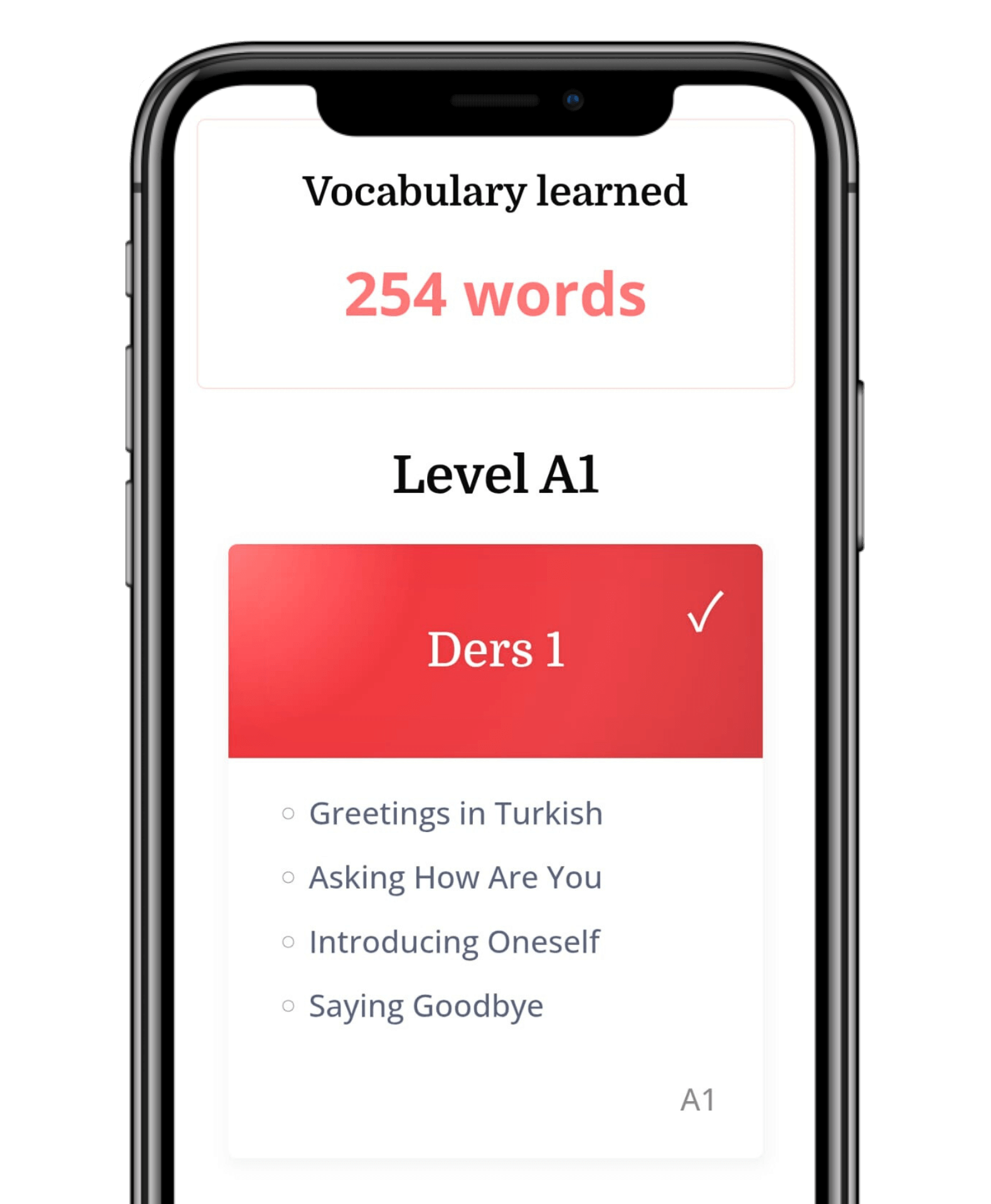
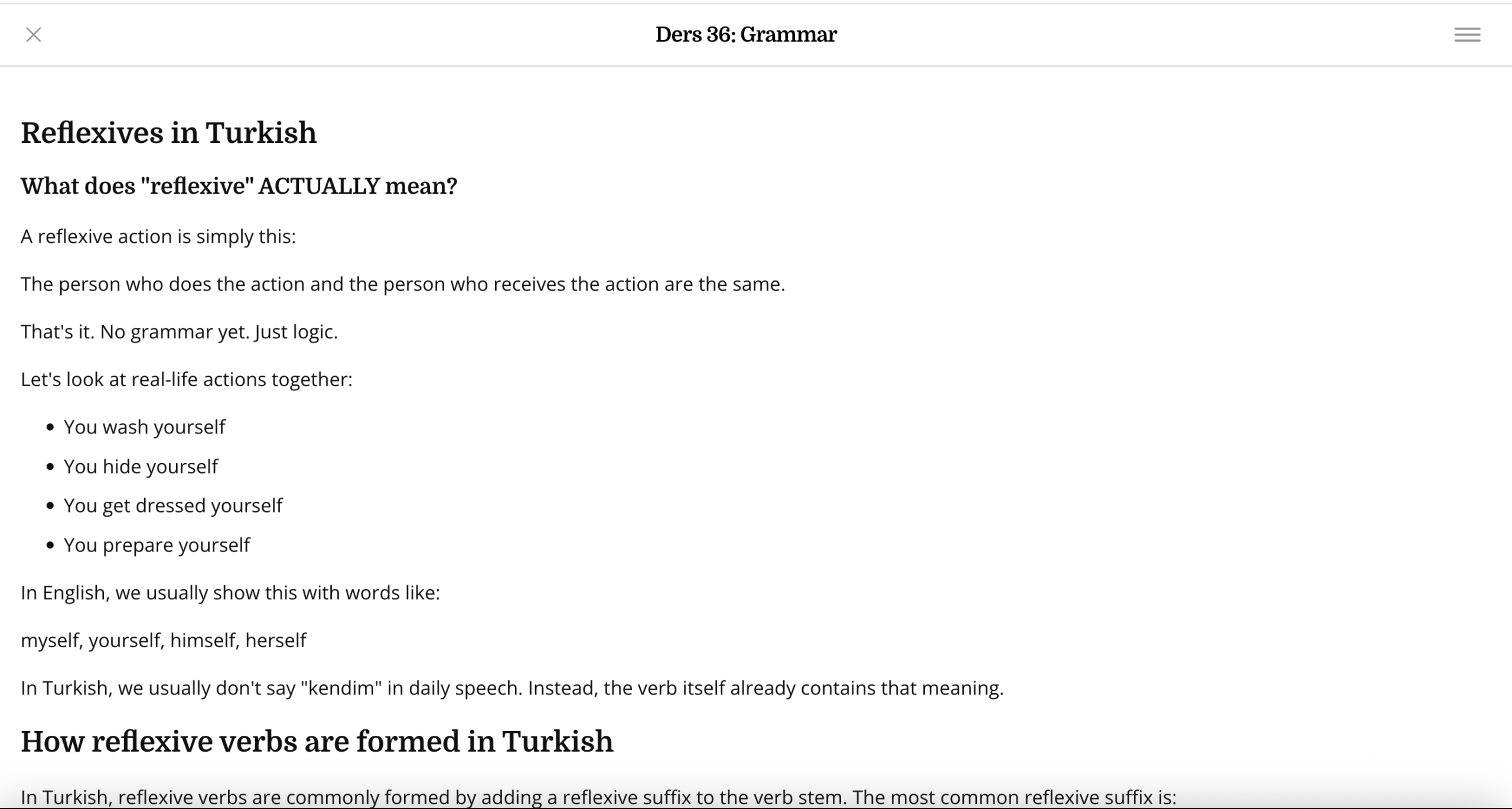
Where Duolingo shows a correct sentence and moves on, TurkishFluent stops to explain the logic first. A concept like reflexive verbs starts from plain reasoning, that the person who acts and the person acted on are the same, and only then builds to the suffix. This is the “understand why, not just tap” piece Duolingo leaves out, and every lesson is designed by Sibel Kısacık, a teacher in Istanbul with over ten years of experience.
It Trains Real Listening With Native Dialogues
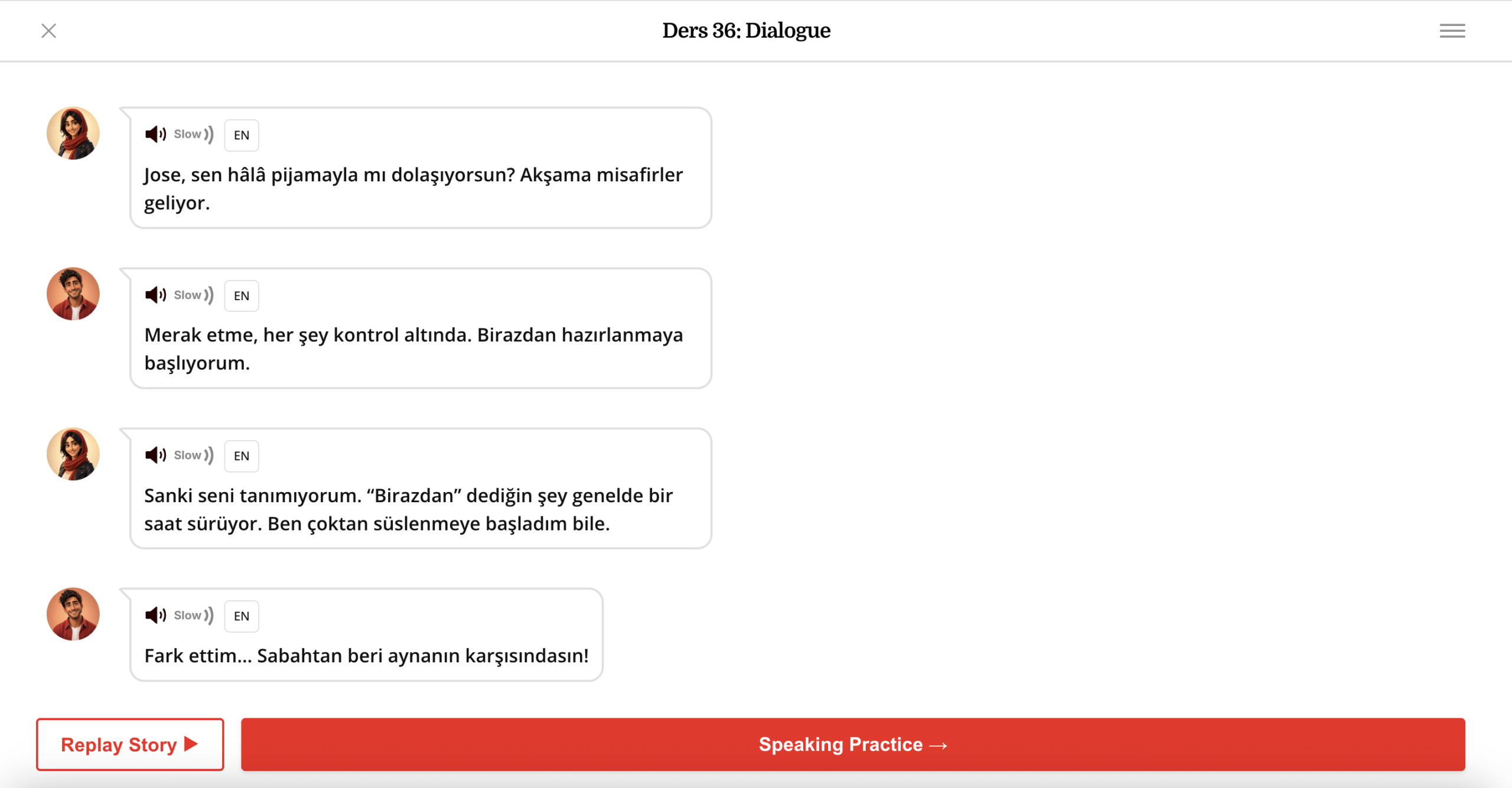
Instead of isolated sentences, each lesson includes a full dialogue between native speakers, playable at normal and slowed speed. You hear how Turks actually string words together, which is exactly the real-time listening that tap exercises never build.
It Grades Your Pronunciation, Word by Word
This is the biggest single upgrade over Duolingo’s pass or fail. TurkishFluent scores every word of a sentence as a percentage, so you can see that altında at 40% needs another try while the rest is solid. Instead of a green check that tells you nothing, you get a map of exactly what to fix.
It Connects You to Real Turkish and Culture
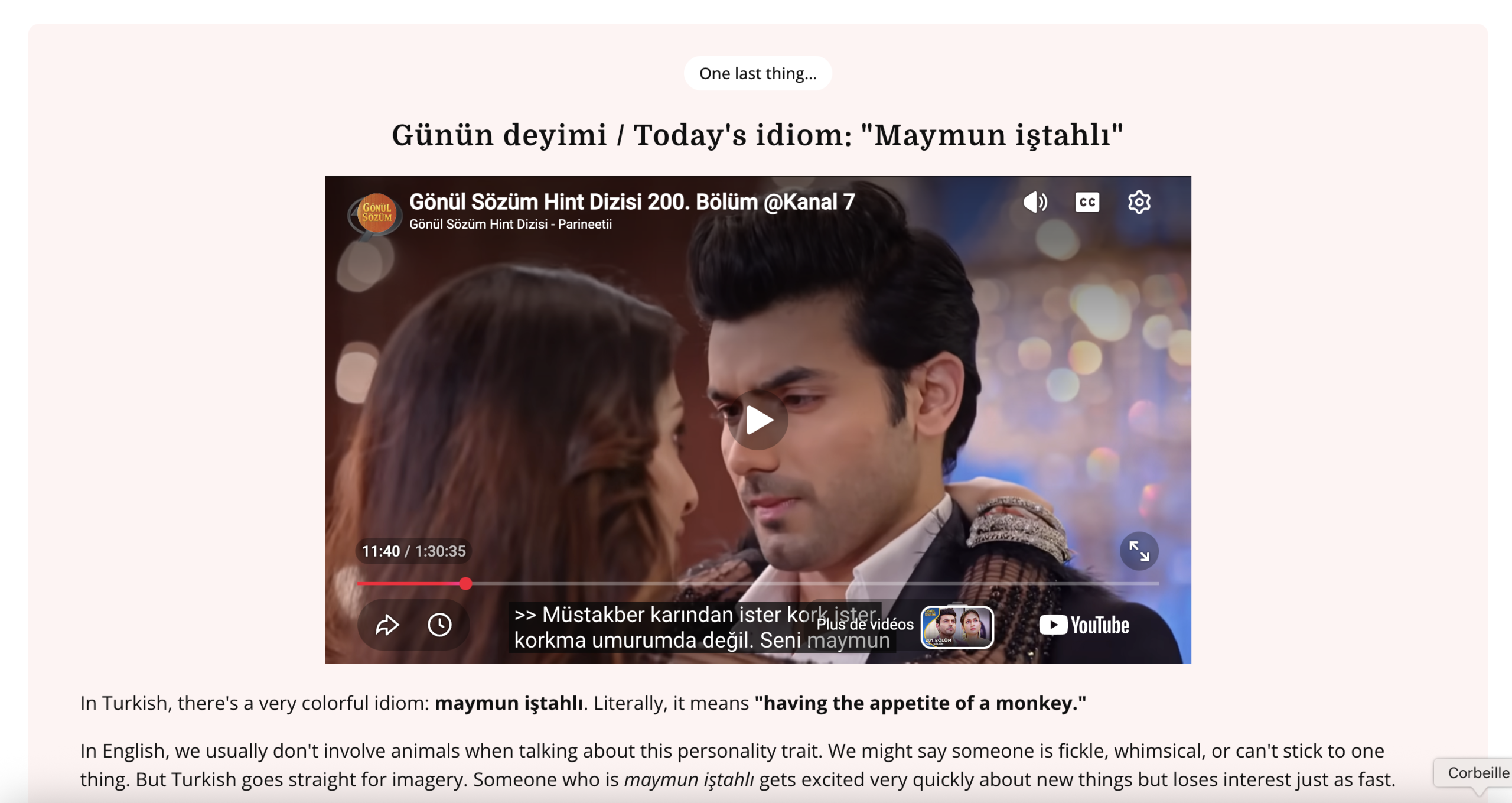
Finally, each lesson closes with an idiom of the day, illustrated with a clip from a real Turkish series. You meet colorful expressions like maymun iştahlı (literally “having the appetite of a monkey”, said of someone fickle) the way Turks actually use them, inside real dialogue on screen.
To be clear, TurkishFluent is not a casual game the way Duolingo is. It asks a bit more focus, because it teaches the real machinery of the language, and that trade is the whole point. In practice, Duolingo keeps your streak alive, while a structured method like this teaches the grammar and speaking Duolingo never reaches.
My Verdict in Five Points
After finishing the Turkish tree myself, here is where I honestly land:
- Duolingo is genuinely good for beginner vocabulary. It builds a solid base of everyday words and simple sentences, at no cost, and it makes the habit stick.
- You absolutely need a grammar course or a teacher alongside it. Duolingo will not explain the case system or vowel harmony, so pair it with a structured grammar method (TurkishFluent is my pick) or a real tutor.
- On its own, it tops out around A2, early B1 at best. Duolingo will not carry you past that ceiling into comfortable, real conversation.
- Keep it as daily practice, but real-life conversation is mandatory. Use the app to stay consistent, then speak with actual people in actual situations. That is where Turkish finally clicks.
- Try TurkishFluent if you want to speak with locals fast. It focuses on the grammar and vocabulary you actually use day to day, explains the why behind each rule, and trains pronunciation and native dialogue, so you move toward real conversation instead of stalling at the A2 ceiling.