Learning Turkish feels intimidating at first, yet the language is more logical than almost any you have studied before. Turkish spells words exactly as they sound, follows clear rules with very few exceptions, and builds meaning by stacking suffixes onto a root. Once you understand its internal logic, progress comes faster than you expect.
In this article, you will learn a complete, ordered method to go from absolute beginner to real conversation. You will discover which skill to build first, why vowel harmony is the engine of the whole language, how to learn grammar without memorizing endless tables, and how to stay consistent long enough to actually speak. Haydi başlayalım!
Table of Contents
The Turkish Learning Path at a Glance
Before diving into each step, here is the full roadmap. Each stage builds on the one before it, so resist the urge to skip ahead.
| Stage | Focus | Example milestone |
|---|---|---|
| 1. Foundations | Alphabet and pronunciation | Read any Turkish word aloud correctly |
| 2. The engine | Vowel harmony | Predict which suffix vowel to use |
| 3. The logic | Agglutination and suffixes | Understand evlerimizde without a dictionary |
| 4. Core grammar | Cases, then tenses | Form a full sentence in past and present |
| 5. Vocabulary | Frequency and context | Know the top 1,000 everyday words |
| 6. Listening and speaking | Native audio and output | Follow a slow dialogue and reply |
| 7. Immersion | TV, podcasts, real talk | Order food and chat with locals |
Follow this order and each new topic will feel like a natural next step, not a wall.
Order that çay in Turkish
Become fluent in Turkish with real-life dialogues & interactive exercises tailored for expats living in Türkiye.
Step 1: Start With the Alphabet and Pronunciation
Your very first task is the Turkish alphabet. It uses the Latin script, so most letters look familiar. However, several letters carry sounds English does not have, and a few familiar-looking letters sound different than you would guess.
The good news is that Turkish is almost perfectly phonetic. Every letter maps to exactly one sound, and that sound never changes. As a result, once you learn the alphabet, you can read any word correctly, even words you have never seen. To master the letters and their sounds, start with our guide to the Turkish alphabet.
Pay special attention to the six letters that trip up beginners:
- ı (dotless i): a flat, throaty sound with no English equivalent
- ö and ü: front rounded vowels, like the German ö and ü
- c: pronounced like the English “j” in “jam”
- ç: pronounced like the English “ch” in “chair”
- ş: pronounced like the English “sh” in “ship”
- ğ (soft g): silent, it simply lengthens the vowel before it
Spend a few days here, not a few minutes. Solid pronunciation early on saves you from bad habits later. For a deeper walkthrough of every sound, follow our Turkish pronunciation guide for beginners.
Step 2: Understand Vowel Harmony, the Engine of Turkish
If you learn only one concept well at the start, make it vowel harmony (ünlü uyumu). This single rule governs how nearly every suffix attaches to a word. Master it, and the rest of Turkish grammar suddenly clicks into place.
Turkish has eight vowels, split into two groups. Back vowels are a, ı, o, u. Front vowels are e, i, ö, ü. The core idea is simple: the vowels inside a word tend to match each other. When you add a suffix, its vowel shifts to harmonize with the last vowel of the root.
Take the plural suffix, which is either -lar or -ler:
- ev (house) becomes evler (houses), because e is a front vowel
- kitap (book) becomes kitaplar (books), because a is a back vowel
This pattern repeats across the entire language. Cases, tenses, possessives, and questions all follow it. Therefore, learning vowel harmony now pays off in every future lesson. Take the time to study our full guide to vowel harmony in Turkish before moving on to grammar.
Step 3: Learn the Agglutinative Logic Instead of Memorizing
Turkish is an agglutinative language. That word sounds technical, yet the idea behind it is beautiful and freeing. Instead of using separate words for “in,” “my,” or “the,” Turkish stacks small suffixes onto a root, one after another, like beads on a string.
Look at how much meaning fits into one word:
- ev: house
- evler: houses
- evlerim: my houses
- evlerimde: in my houses
- evlerimdeydi: it was in my houses
Each suffix adds one clear piece of meaning, always in a fixed order. Once you know the building blocks, you can read a long word by peeling it apart from left to right. This is why memorizing whole phrases is the wrong strategy. Instead, learn the suffixes and the rules that combine them.
This mindset shift matters more than any single grammar point. Beginners who try to memorize sentences burn out fast. Learners who understand the logic can generate thousands of correct words from a handful of rules. In short, you are learning a system, not a phrasebook.
Step 4: Build Core Grammar in the Right Order
Grammar is where many self-taught learners get lost, usually because they study topics in a random order. A clear sequence prevents that. Build the cases first, then move to verb tenses.
Learn the Grammatical Cases First
The cases tell you the role a noun plays in a sentence: where something is, where it is going, what the direct object is. Turkish marks these with suffixes rather than word order or prepositions. Learn them in this order, from most concrete to most abstract:
| Case | Suffix | Function | Example |
|---|---|---|---|
| Nominative | (none) | The subject | ev (house) |
| Accusative | -(y)ı/i/u/ü | The definite object | evi (the house) |
| Dative | -(y)a/e | To, toward | eve (to the house) |
| Locative | -da/de/ta/te | In, at, on | evde (at home) |
| Ablative | -dan/den/tan/ten | From | evden (from home) |
| Genitive | -(n)ın/in/un/ün | Possession | evin (of the house) |
Notice how every suffix obeys vowel harmony. This is exactly why Step 2 came first. Once the cases feel natural, you can say where you are, where you are going, and what you want, which covers most daily needs.
Then Move to the Verb Tenses
With the cases in place, turn to verbs. Turkish verbs also stack suffixes for tense, person, and negation. Start with the present continuous (şimdiki zaman), because it covers most everyday actions. Then add the simple past, the future, and the aorist for habits and general truths.
Turkish word order also differs from English. The verb almost always comes last, following a subject-object-verb pattern. To understand why and how to build correct sentences, study Turkish sentence structure and word order early on. It will make every example sentence clearer.
Step 5: Grow Your Vocabulary the Smart Way
Vocabulary is fuel, but not all words are worth the same effort. The smart approach combines frequency with context. Learn the most common words first, and learn them inside real sentences rather than isolated lists.
Focus your first months on the words you will use constantly:
- Everyday nouns: su (water), ev (house), yemek (food), iş (work)
- Core verbs: olmak (to be), gitmek (to go), yapmak (to do), istemek (to want)
- Question words: ne (what), nerede (where), kim (who), nasıl (how)
- Numbers, days, and common adjectives
Aim for the top 1,000 words before worrying about rare vocabulary. These high-frequency words appear again and again, so every one you learn unlocks dozens of real sentences. Furthermore, learning words in context helps you remember them and shows you how they behave with suffixes. A flashcard that says okula gidiyorum (I am going to school) teaches you far more than the single word okul.
To build this core the smart way, work through the TurkishFluent vocabulary section. It groups the highest-frequency words by theme and pairs each one with native audio, so you learn them in context instead of memorizing flat lists.
Step 6: Train Listening and Speaking With Native Audio
Reading and grammar build your foundation, yet you cannot speak a language you never hear. Train your ears early, and do it with native audio rather than robotic text-to-speech.
Real Turkish spoken at natural speed will overwhelm you at first, and that is normal. The trick is to use audio recorded at two speeds. Listen to a dialogue slowed down until you catch every word, then listen to the same dialogue at normal speed. Over time, the gap between the two shrinks until natural speech feels comfortable.
Speaking is the other half. You must produce the language, not just recognize it. Start small: read example sentences aloud, imitate the rhythm and intonation of native speakers, and repeat dialogues line by line. Modern tools make this easier than ever. In the TurkishFluent app, for instance, AI pronunciation training lets you speak a sentence and get instant feedback on what to fix, which is the closest thing to a patient tutor in your pocket.
Step 7: Immerse Yourself in Real Turkish
Once you have a foundation, immersion turns study into fluency. You do not need to move to Istanbul, though it helps. You can build a Turkish environment right where you are.
Weave the language into your daily life through several channels:
- TV series and films: Turkish dramas are famous worldwide and full of natural speech
- Podcasts and music: passive listening trains your ear during commutes or chores
- YouTube channels: many creators teach and entertain in simple Turkish
- Real conversations: language exchange partners, local friends, or a Turkish colleague
Start with subtitles, then wean yourself off them as you improve. The goal is regular, enjoyable exposure. For a curated starting point, browse our list of 12 useful resources for learning Turkish, which points you to tools worth your time.
A Realistic Timeline and How to Stay Consistent
Honesty matters here. Turkish is not the hardest language for an English speaker, but its structure is unfamiliar, so give yourself realistic expectations. With steady daily practice, most learners reach a comfortable conversational level in about a year.
Here is a rough map of what to expect:
| Timeframe | Level | What you can do |
|---|---|---|
| 1 month | Absolute beginner | Read aloud, greet people, use basic phrases |
| 3 months | A1 to A2 | Handle shopping, ordering, simple questions |
| 6 months | A2 to B1 | Hold short conversations on familiar topics |
| 12 months | B1 | Talk about daily life, follow slow media |
The single biggest factor is not talent, it is consistency. Ten focused minutes every day beat a three-hour cram session once a week. Short daily practice keeps the language fresh in your memory and builds a habit that survives busy weeks. To set your own expectations more precisely, read our honest take on how long it takes to learn Turkish.
Common Mistakes Beginners Make
A few predictable errors slow learners down. Avoid these, and you will progress far faster than most.
- Skipping the alphabet and vowel harmony. These are the foundation. Rush them, and every later topic feels harder than it should.
- Memorizing phrases instead of learning the logic. A phrasebook helps for a vacation, not for fluency. Learn the suffix system instead.
- Studying grammar in a random order. Cases before tenses, concrete before abstract. Sequence matters.
- Ignoring listening until “later.” Your ear needs months to adjust. Start on day one, even at a slow speed.
- Practicing in long, rare bursts. Consistency beats intensity every time. Protect your daily ten minutes.
- Fearing mistakes. Turks are warm and encouraging with learners. Speaking imperfectly is how you improve.
If you are worried the language is simply too difficult, our guide on whether Turkish is hard to learn will reassure you with a clear-eyed look at the real challenges.
How TurkishFluent Follows This Exact Method
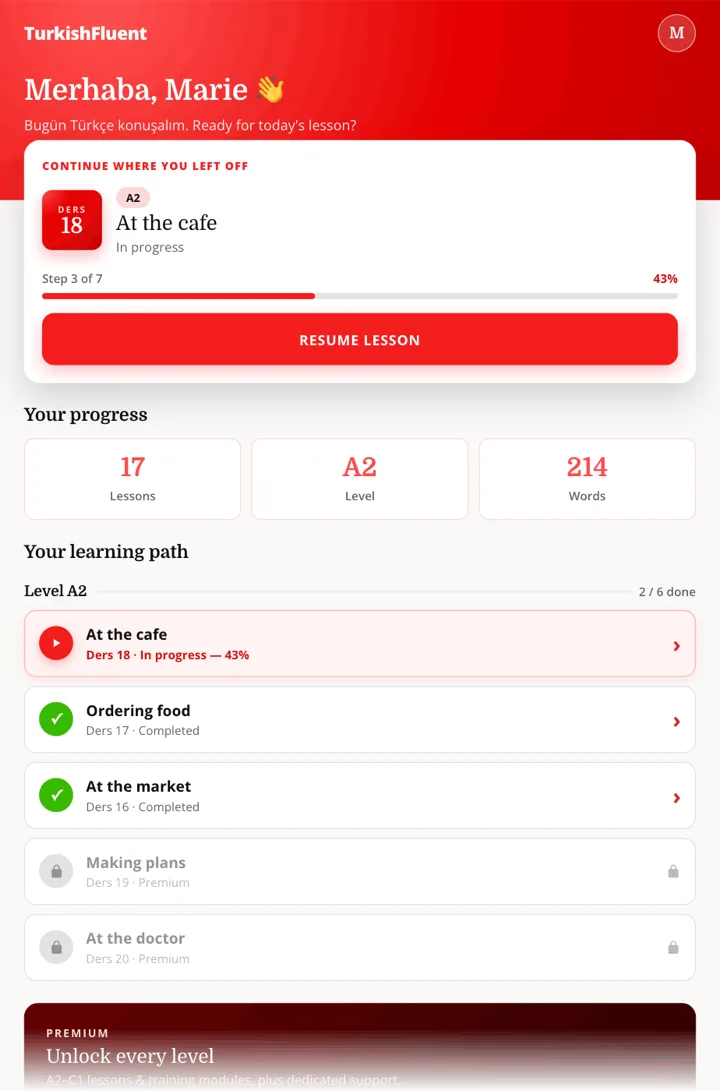
This method is not theoretical. It is the structure I used to design the TurkishFluent app, built for people who want practical, structured Turkish rather than endless gamified streaks. The lessons follow the same progression as this guide, in the same order, so you never feel lost about what to study next.
Here is what that looks like in practice:
- Structured grammar, designed by a professional Turkish teacher in Istanbul, that moves from the alphabet through vowel harmony, the cases, and the tenses in a logical sequence
- Native dialogues recorded by real speakers at both normal and slowed speed, exactly the two-speed listening approach from Step 6
- AI pronunciation training so you speak from the very first lessons and get instant feedback
- Ten-minute daily lessons built around the consistency principle, easy to fit into a busy day
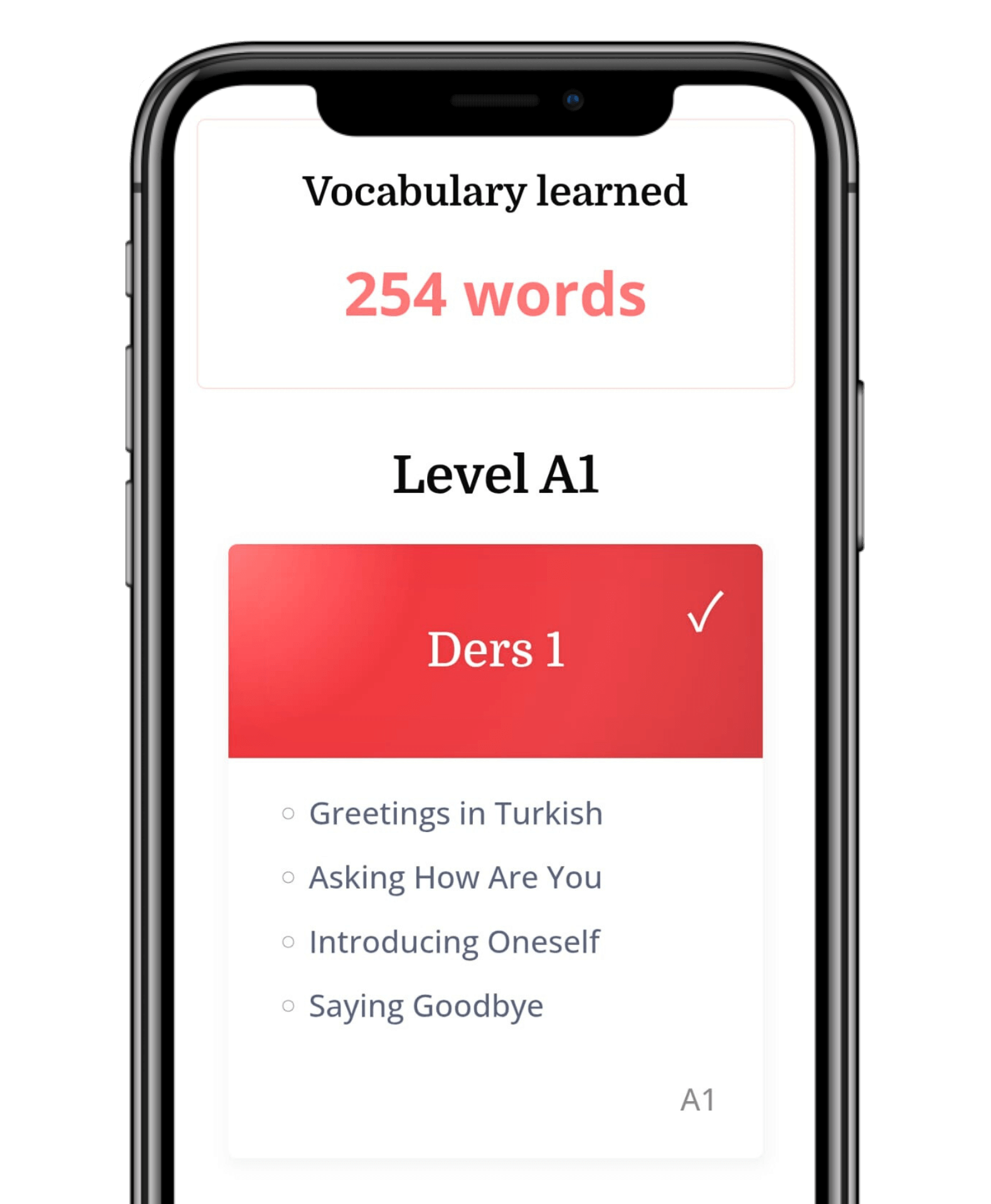
Best of all, the entire A1 level, 16 full lessons, is free forever. That covers greetings, plurals, the locative case, and the foundational grammatical cases, the exact building blocks this article describes. You can start today at no cost and see whether the method works for you before spending anything.