When learning Turkish, mastering how to express percentages and fractions is an essential part of everyday communication, whether you’re discussing prices, quantities, or mathematical concepts. In this guide, we will explain how to talk about percentages and fractions in Turkish. Iyi okumalar!
1. How to Express Percentages in Turkish
In Turkish, we use the word “yüzde” (which translates to “percent”) followed by the numerical value to express a percentage. Be careful, the percent sign comes before the numerical value in Turkish (unless like in English or other latin languages).
Structure:
- yüzde + [number]
Examples:
- %4 – yüzde dört (4 percent)
- %8.9 – yüzde sekiz nokta dokuz (8.9 percent)
- %50 – yüzde elli (50 percent)
- %99.12 – yüzde doksan dokuz nokta on iki (99.12 percent)
Notice that decimals are indicated using the word “nokta” (point), similar to English.
Possessive Suffixes with Percentages
Possessive suffixes can be added to percentages to indicate who or what is associated with the percentage. Here’s how they are typically used:
- %20’si (yüzde yirmisi): – “its twenty percent” or “twenty percent of it”
- Ürünün yüzde yirmisi indirimde. (Twenty percent of the product is on sale.)
- %15’imiz (yüzde on beşimiz): – “fifteen percent of us”
- Toplantıya yüzde on beşimiz katıldı. (Fifteen percent of us attended the meeting.)
- %60’ınız (yüzde altmışınız): – “sixty percent of you”
- Sınavı yüzde altmışınız geçti. (Sixty percent of you passed the exam.)
Order that çay in Turkish
Become fluent in Turkish with real-life dialogues & interactive exercises tailored for expats living in Türkiye.
2. How to Express Fractions in Turkish
In Turkish, expressing fractions can vary slightly depending on the type of fraction: proper, improper, mixed, or decimal.
2.1 Proper Fractions
Proper fractions in Turkish are often expressed using a locative construction. This means the denominator (the lower part of the fraction) takes a locative suffix (-DA/DE) and is followed by the numerator (the upper part of the fraction) in its nominative form. Again, the order is inverted in Turkish, the denominator coming first!
Structure:
- Denominator + -da/de + numerator
Examples:
- 1/8 – sekizde bir (one-eighth)
- 3/5 – beşte üç (three-fifths)
- 1/4 – dörtte bir (one-fourth)
An alternative way to express fractions, especially in more formal or mathematical contexts, is by using the word “bölü,” which means “divided by.” In that case, the order is the same as in English.
Structure:
- Numerator + bölü + denominator
Examples:
- 1/8 – bir bölü sekiz
- 3/5 – üç bölü beş
2.2 Improper Fractions and Mixed Numbers
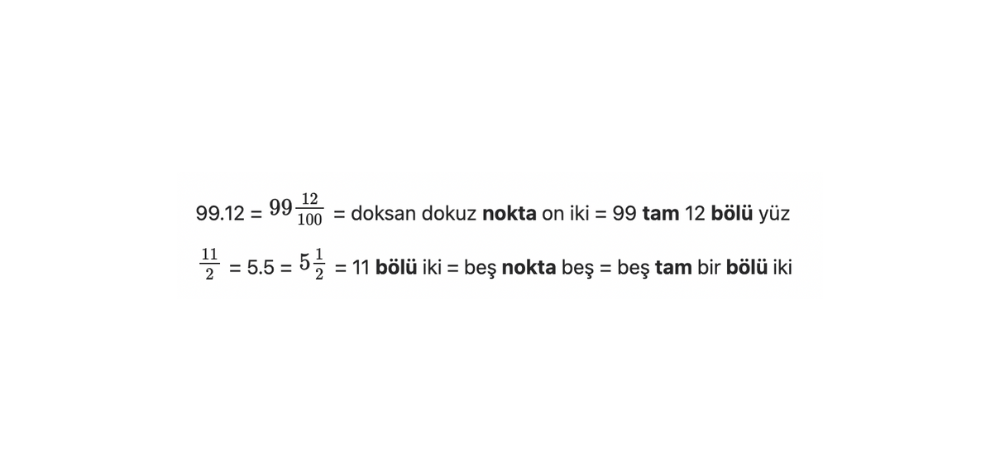
Improper fractions (where the numerator is larger than the denominator) can be expressed using “bölü.” However, these are often converted into mixed numbers. When converted, the integer part is expressed using the word “tam” (whole), and the remaining fraction is written in the “bölü” structure.
Structure:
- Integer + tam + numerator + bölü + denominator
Examples:
- 11/2 – on bir bölü iki = beş tam bir bölü iki = beş nokta beş
- 9/4 – dokuz bölü dört = iki tam bir bölü dört = iki nokta yirmi beş
2.3 Decimal Fractions
Decimal numbers in Turkish use “nokta” as the decimal separator. This is very similar to how English uses “point.”
Structure:
- Whole number + nokta + decimal digits
Examples:
- 0.125 – sıfır nokta yüz yirmi beş (zero point one hundred twenty-five)
- 5.5 – beş nokta beş (five point five)
- 99.12 – doksan dokuz nokta on iki (ninety-nine point twelve)