
Starting a new language is exciting, but the first question is always the same: where do I actually begin? Turkish has a clear, logical structure, so a beginner who follows the right order learns fast. The trick is to build each skill on the one before it, instead of jumping around at random.
In this article, you will learn what A1 Turkish really means, what you can do once you reach it, and the exact 16-lesson path that takes you from your very first sound to introducing yourself with confidence. I designed this roadmap around the free A1 track inside the TurkishFluent app, so you can follow every step in order. Haydi başlayalım!
Table of Contents
What A1 Turkish Means
A1 is the first level of the CEFR, the standard scale used to measure language ability across Europe. In plain terms, A1 is the true beginner stage. You are not fluent yet, and that is fine. Instead, you learn to handle simple, predictable everyday situations.
By the end of A1, you can do a surprising amount. Specifically, you can:
- Greet people and say goodbye politely
- Introduce yourself and ask someone their name
- Count, tell prices, and share your phone number
- Ask and answer simple questions
- Say where things are and where you are going
- Order food, shop, and manage basic daily errands
That is the real goal of this level. You will not discuss politics or write essays. However, you will survive your first weeks in Turkey and start real, if simple, conversations. Above all, A1 gives you the grammar foundations that every later level depends on.
Here is the full A1 journey, grouped into blocks so you can see the logic at a glance:
| Lesson block | What you learn |
|---|---|
| Lessons 1-2: Sounds and spelling | The Turkish alphabet, clear pronunciation, and vowel harmony, the rule behind almost every suffix |
| Lessons 3-4: Your first words | Greetings, polite phrases, and the personal pronouns (I, you, he, she) |
| Lessons 5-6: Being and having | The “to be” suffixes for simple sentences, plus var and yok for “there is” and “there is not” |
| Lessons 7-9: Core grammar | Plurals, the present continuous tense, and how to turn any sentence into a question |
| Lessons 10-11: Numbers and place | Counting from zero upward, then the locative case to say where something is |
| Lessons 12-14: The grammatical cases | The accusative, dative, and ablative cases, the engine of Turkish word endings |
| Lessons 15-16: Putting it together | Everyday phrases for real situations, then introducing yourself from start to finish |
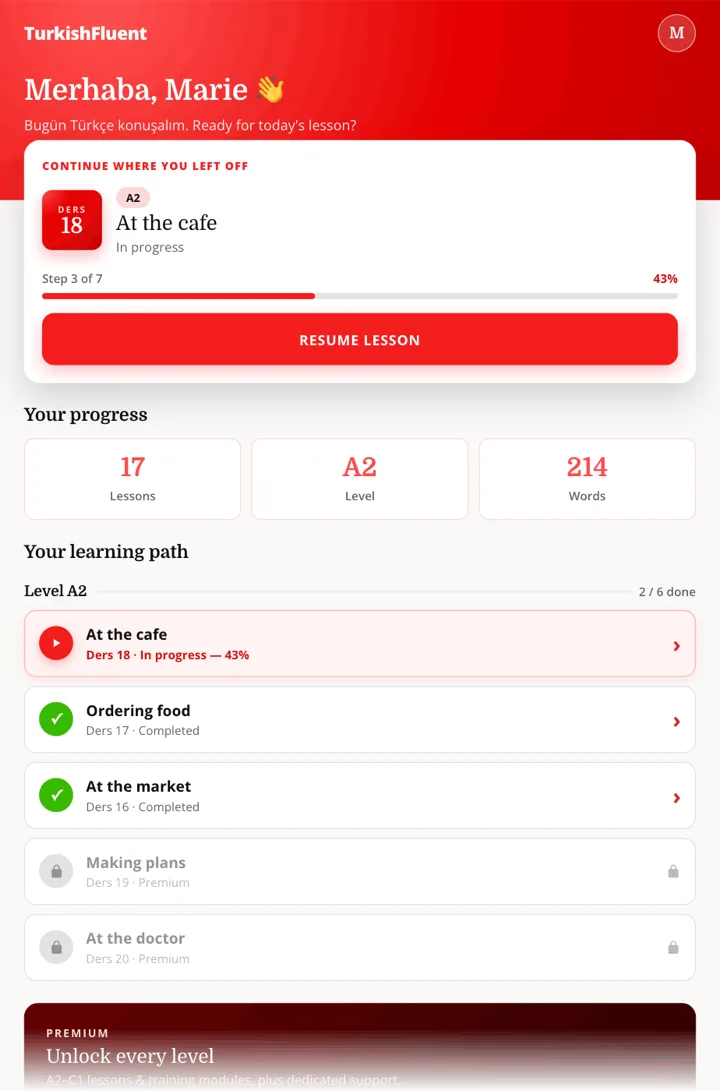
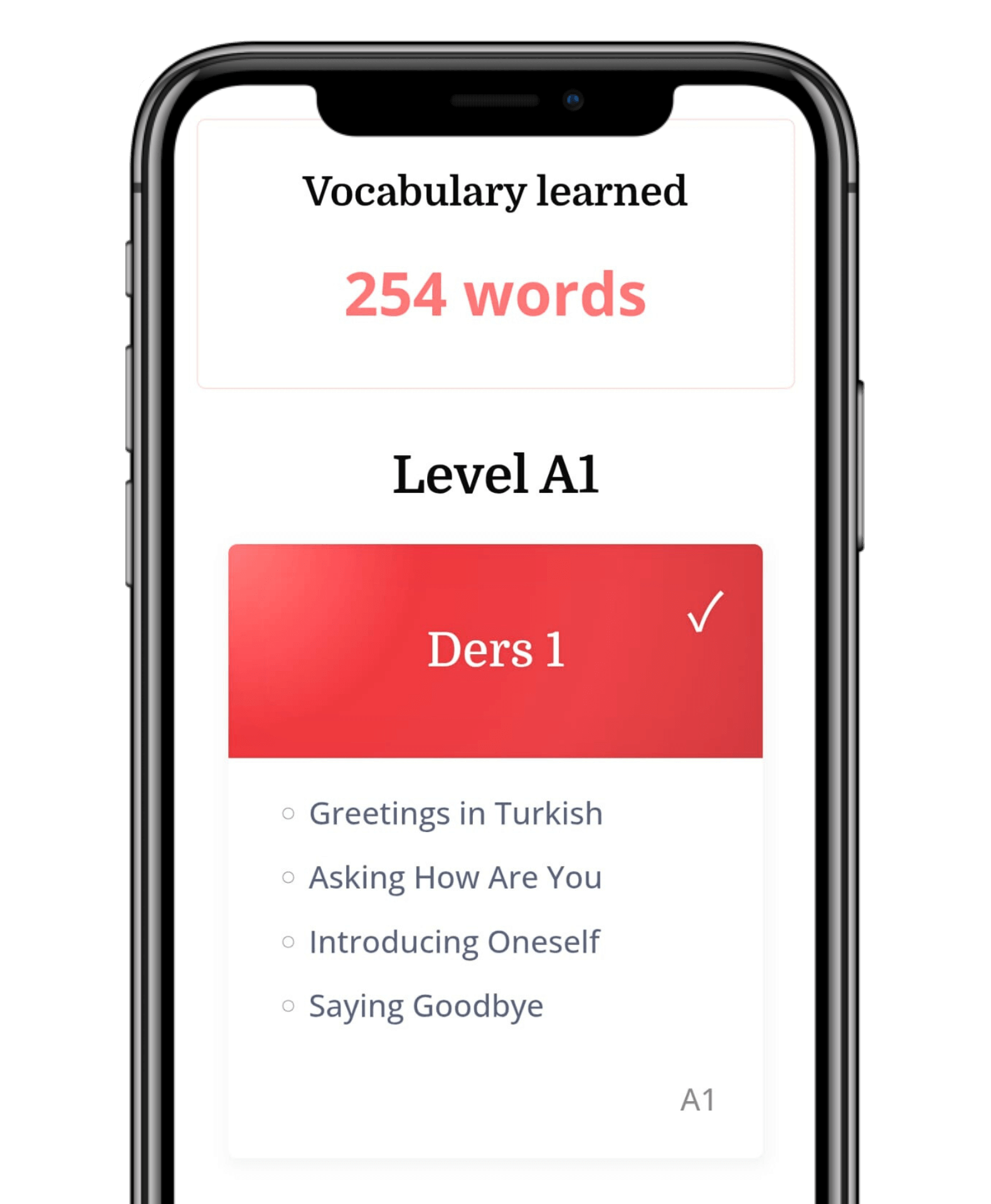
Every one of these 16 lessons is free forever in the TurkishFluent app. The paywall only starts at A2, so your entire foundation costs nothing. Now let us walk through the path lesson by lesson.
Order that çay in Turkish
Become fluent in Turkish with real-life dialogues & interactive exercises tailored for expats living in Türkiye.
Lessons 1-2: Master the Sounds First
Turkish is phonetic, which means you read words exactly as they are written. Once you know the sounds, you can pronounce any word on the page. Therefore, the alphabet comes first, before any grammar.
Lesson 1 introduces the Turkish alphabet. It has 29 letters, and a few of them look unfamiliar at first. You will meet the dotless ı, the soft ğ, and the shushing ş and ç. Each one has a single, consistent sound. For a full breakdown of every letter, work through our guide to the Turkish alphabet alongside this lesson.
- Merhaba (Hello) shows the clear, open Turkish vowels.
- Çay (Tea) shows how ç sounds like the “ch” in “chair.”
Lesson 2 covers pronunciation and, crucially, vowel harmony. This is the single most important rule in the whole language. In short, the vowels inside a word must match, and suffixes change their vowel to fit the word they attach to. It sounds abstract now, but it controls almost every ending you will ever add. Study it early with our guide to vowel harmony in Turkish, and the rest of A1 becomes far easier.
- evler (houses) keeps front vowels together.
- kitaplar (books) keeps back vowels together.
Lessons 3-4: Greet People and Name Yourself
With the sounds in place, you can finally start speaking. These two lessons give you your first real, usable words.
Lesson 3 teaches greetings and polite phrases. You learn to say hello, ask how someone is, and respond warmly. Turkish has more than one way to greet, and each fits a different moment. To go deeper, explore the 8 ways to say hello in Turkish after this lesson.
- Günaydın (Good morning) for the start of the day.
- Nasılsın? (How are you?) to open almost any conversation.
Lesson 4 introduces the personal pronouns: ben (I), sen (you), o (he, she, it), and their plurals. Turkish often drops the pronoun because the verb ending already shows who is acting. Still, you need to recognise them clearly. For the full set, including formal and plural forms, see our guide to Turkish pronouns.
- Ben öğrenciyim. (I am a student.)
- Sen nerelisin? (Where are you from?)
Lessons 5-6: Say What Something Is and What Exists
Now you start building sentences. Turkish makes simple statements without a separate verb “to be,” which surprises many beginners at first.
Lesson 5 teaches the “to be” suffixes. Instead of a word like “am” or “is,” you add a small ending to the word itself. This lets you say what you are, where you are, and how you feel. Consequently, you can form complete sentences with almost no vocabulary.
- Yorgunum. (I am tired.)
- O doktor. (He is a doctor.)
Lesson 6 introduces var (there is) and yok (there is not). These two tiny words do a huge amount of work in daily life. You use them to say what exists, what is available, and what you have. For example, they appear constantly when you shop or order.
- Masada çay var. (There is tea on the table.)
- Bugün ekmek yok. (There is no bread today.)
Lessons 7-9: Build Real Sentences
This block turns your simple statements into flexible, natural sentences. These three lessons are the grammatical heart of A1.
Lesson 7 covers plurals. Turkish forms them with a single suffix, -lar or -ler, chosen by vowel harmony. There are no irregular plurals to memorise, which is a real relief. Practise the pattern with our guide on how to form plurals in Turkish, and you will never guess again.
- bir kedi (one cat) becomes kediler (cats).
- bir ev (one house) becomes evler (houses).
Lesson 8 introduces the present continuous tense, or şimdiki zaman, built with -iyor. This is the first verb tense you learn, and it covers what you are doing now and around now. As a result, you can finally describe actions, not just states.
- Geliyorum. (I am coming.)
- Ne yapıyorsun? (What are you doing?)
Lesson 9 teaches you to ask questions with the particle mi. It attaches near the end of the sentence and turns any statement into a yes-or-no question. Meanwhile, question words like ne (what) and nerede (where) let you ask for details.
- Çay içiyor musun? (Are you drinking tea?)
- Bu ne? (What is this?)
Lessons 10-11: Count and Locate
With sentences under control, you add two skills you will use every single day in Turkey: numbers and location.
Lesson 10 covers numbers and counting. Turkish numbers are wonderfully regular, so once you learn zero to ten, larger numbers follow a clear pattern. You need them for prices, time, phone numbers, and addresses. For the complete system, study the numbers in Turkish.
- bir, iki, üç (one, two, three)
- Bu kaç lira? (How much is this?)
Lesson 11 introduces the locative case, formed with -de or -da. It answers the question “where?” and marks the place where something is. This is your first grammatical case, and it opens the door to the others. Learn it thoroughly with our guide to the locative case in Turkish.
- Evdeyim. (I am at home.)
- Kitap masada. (The book is on the table.)
Lessons 12-14: Master the Grammatical Cases
Cases are what make Turkish tick. Each one adds a small ending that shows a noun’s role in the sentence. You already met the locative, so now you complete the core set. Take these three lessons slowly, because they repay every minute you spend on them.
Lesson 12 teaches the accusative case, which marks a specific direct object. You use it when you act on a particular, known thing. In other words, it shows the “the” behind the object.
- Kitabı okuyorum. (I am reading the book.)
Lesson 13 covers the dative case, the “to” or “toward” ending. It marks direction and the receiver of an action. Therefore, it appears whenever you go somewhere or give something to someone.
- Okula gidiyorum. (I am going to school.)
Lesson 14 introduces the ablative case, the “from” ending. It marks origin, source, and starting points. For instance, you use it to say where you come from or what you are made of.
- İstanbuldan geliyorum. (I am coming from Istanbul.)
Together with the locative, these cases let you describe movement and position with precision. They feel mechanical at first. However, with a little practice they become automatic, and your sentences suddenly sound Turkish.
Lessons 15-16: Speak in Real Situations
The final block brings everything together. Here you stop drilling grammar and start using it for the moments that matter.
Lesson 15 gives you everyday phrases for real situations: ordering food, shopping, asking for directions, and handling small talk. These set phrases let you communicate before your grammar is perfect. Consequently, you gain confidence fast and feel less stuck.
- Bir çay lütfen. (One tea, please.)
- Hesap, lütfen. (The bill, please.)
Lesson 16 is the payoff. You learn to introduce yourself from start to finish: your name, where you are from, what you do, and a few details about your life. This lesson weaves together the pronouns, the “to be” suffixes, and the cases you have built across the whole level. For a full script you can adapt, follow our guide on how to introduce yourself in Turkish.
- Merhaba, benim adım Ali. (Hello, my name is Ali.)
- Fransadan geliyorum ve İstanbulda yaşıyorum. (I am from France and I live in Istanbul.)
By this point, you have crossed the A1 finish line. You can greet, count, ask, locate, and introduce yourself. That is a real, working foundation.
Why Follow This Exact Order
The order matters as much as the content. Each lesson unlocks the next, so nothing feels random or overwhelming. You learn the sounds before the words, the words before the sentences, and the sentences before the cases. As a result, every new idea lands on ground you already understand.
I built the free A1 track in TurkishFluent around exactly this progression. All 16 lessons stay free forever, with no trial clock and no paywall until A2. Moreover, each lesson pairs the grammar with native dialogues recorded at normal and slowed speed, so you hear real Turkish from day one. You also get AI pronunciation practice, where you speak and receive instant feedback on your sounds.
The lessons are short by design, about ten minutes each. That length fits a busy day, and it keeps you coming back. Ten focused minutes daily beats a rare, exhausting marathon every time. In fact, small daily reps are how the alphabet, vowel harmony, and the cases finally click.
The structured grammar behind the app was designed by Sibel Kısacık, a professional Turkish teacher in Istanbul with more than ten years of experience. So you are not following a random playlist. Instead, you follow a real teacher’s course, sequenced the way she teaches it in class.
Conclusion
A1 Turkish takes you from your very first sound to a genuine self-introduction in sixteen clear steps. From the alphabet and vowel harmony to greetings, plurals, verbs, numbers, and the grammatical cases, each lesson builds directly on the last. That is why the order, not just the content, makes the difference.
Follow this path and, within weeks, you will greet a neighbour, count out change, and order that çay in Turkish without stress. That small, real moment is the whole point of starting.
To take the first step today, start the free A1 level in the TurkishFluent app. All 16 lessons are free forever, so open Lesson 1 and let the roadmap do the rest.


Name is shakila rezai and I am interest to learn Turkish it’s so good for me to learn Turkish with you.