In Turkish, demonstrative pronouns play a crucial role in identifying objects or people based on their proximity to the speaker and listener. Understanding the differences between bu, şu, and o (and their plural forms bunlar, şunlar, and onlar) is sometimes tricky for beginners in Turkish. Here is a guide to explain how to differentiate these pronouns with examples.
Demonstrative Pronouns in Turkish
| Pronoun | Translation | Proximity |
|---|---|---|
| Bu | This | Close to the speaker |
| Şu | That (near) / This | Slightly farther away but still visible or within reach |
| O | That | Far away from both the speaker and listener |
| Plural Form | Translation | Proximity |
|---|---|---|
| Bunlar | These | Close to the speaker |
| Şunlar | Those (near) / These | Slightly farther away but still visible or within reach |
| Onlar | Those | Far away from both the speaker and listener |
Note: when using demonstrative pronouns in plural form, no need to add the plural to the following noun. E.g.: bunlar araba (These are cars and not “bunlar arabalar“)
Order that çay in Turkish
Become fluent in Turkish with real-life dialogues & interactive exercises tailored for expats living in Türkiye.
How to Differentiate “Bu/Bunlar,” “Şu/Şunlar,” and “O/Onlar”?
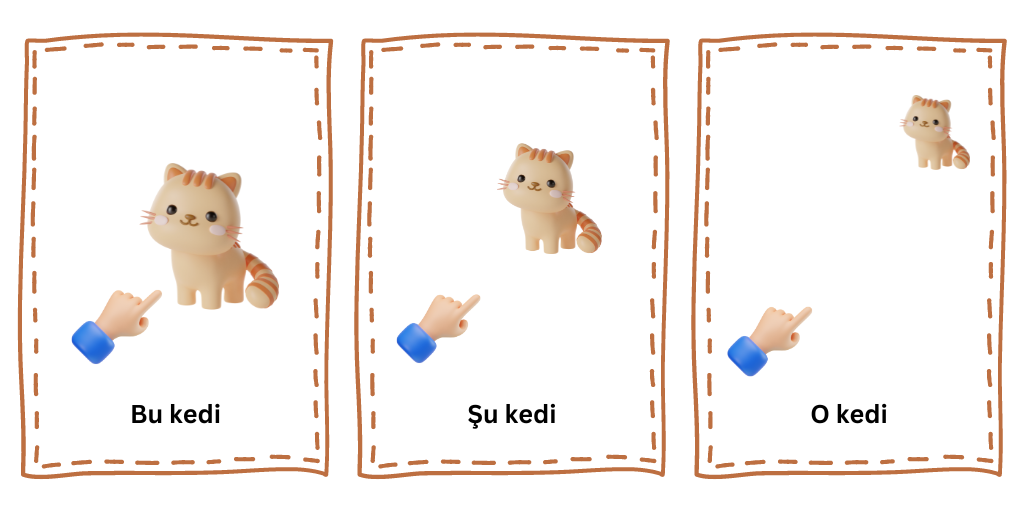
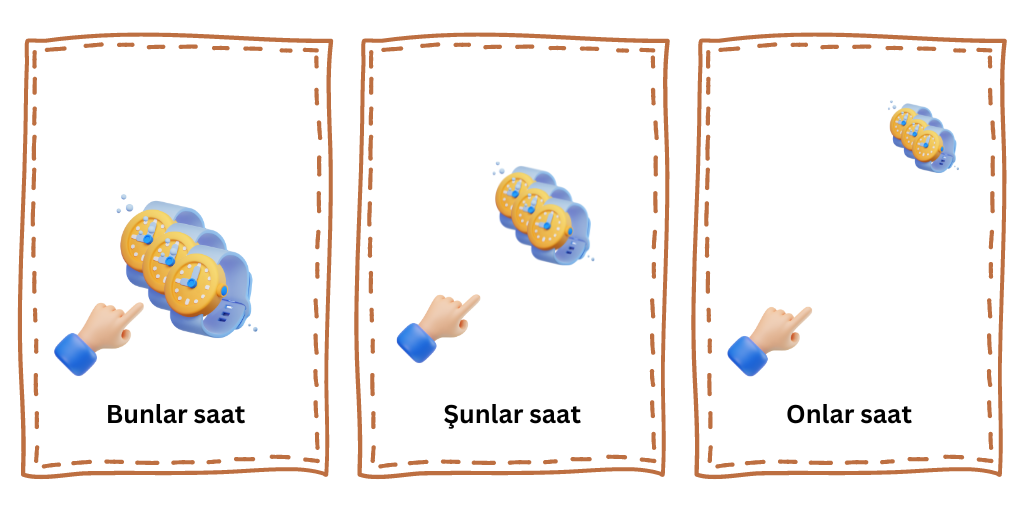
The difference between “bu/bunlar,” “şu/şunlar,” and “o/onlar” lies in the distance between the speaker and the object or person being referred to.
1. Bu (This) and Bunlar (These)
Bu and Bunlar are used to indicate objects or people close to the speaker. They typically refer to something that the speaker can touch or is within arm’s reach.
Examples:
- Bu kedi çok tatlı. (This cat is very cute.)
- Bunlar kitaplarım. (These are my books.)
- Bu araba benim. (This car is mine.)
2. Şu (That / This) and Şunlar (Those / These)
Şu and Şunlar are used for objects or people that are slightly farther away from the speaker but still in sight.
Examples:
- Şu kuş mavi. (That bird is blue.)
- Şunlar elmadefterler. (Those are apples.)
- Şu adam kim? (Who is that man?)
3. O (That) and Onlar (Those)
O and Onlar refer to objects or people far away from both the speaker and listener.
Examples:
- O ev çok büyük. (That house (over there) is very big.)
- Onlar benim arkadaşlarım. (Those are my friends.)
- O ağaç çok uzun. (That tree [over there] is very tall.)
Summary of Demonstrative Pronouns in Turkish
| Proximity | Singular | Plural | Examples (Singular) | Examples (Plural) |
|---|---|---|---|---|
| Close to speaker | Bu | Bunlar | Bu kitap (This book) | Bunlar defter (These are notebooks) |
| Farther but visible | Şu | Şunlar | Şu köpek (That dog) | Şunlar kuş (Those are birds) |
| Far away | O | Onlar | O araba (That car over there) | Onlar hayvan (Those are animals) |
Demonstrative pronouns are taught in the second lesson of TurkishFluent’s course. Sign up now!
To further learn Turkish, discover the difference between “Burada/Burası,” “Şurada/Şurası,” and “Orada/Orası”.